What does cluttering mean?
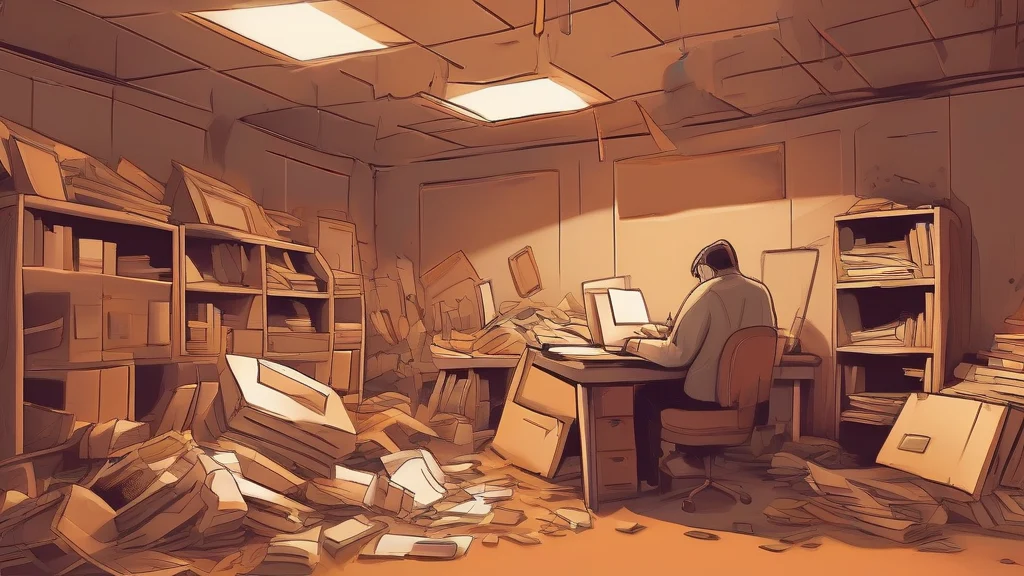
Cluttering has two distinct lives in English. In its specialized sense, it names a lesser-known fluency disorder: speech that is rushed, erratic in rhythm, and loosely organized, with syllables blended together or dropped entirely. Unlike stuttering, which the speaker typically feels acutely, cluttering often goes unnoticed by the person doing it, making diagnosis dependent on listeners or clinicians. More commonly, "cluttering" serves as the present participle and gerund of the verb "clutter," describing the act of filling a space with a jumbled excess of things — papers cluttering a desk, toys cluttering a floor. Both senses carry a connotation of overfullness and disorder, whether in speech or in space. The word rewards attention because it captures a real phenomenon many people recognize but rarely name: communication, or a room, overwhelmed by sheer volume.
A fluency disorder in which speech is abnormally rapid and irregular, with collapsed or omitted syllables and disorganized phrasing, typically without the speaker's awareness.
"The clinician diagnosed cluttering after noting the boy's rapid, slurred delivery and disorganized sentence structure."
Used mainly within speech-language pathology; sometimes called "tachyphemia" in older literature.
Present participle and gerund of "clutter": filling or covering a space with an untidy, excessive collection of things.
"Souvenirs from decades of travel were cluttering every shelf in the house."
Unlike stutterers, people who clutter usually have no idea they're doing it — to them, everyone else just talks too slowly.
Reviewed by Deb Chak, Editor. AI-assisted content curated by RJS Tech Solutions LLP.
Etymology of cluttering
The verb "clutter" arose in English during the sixteenth century, probably as a frequentative form related to "clot," reflecting the idea of matter gathering into an unformed mass. From this verbal root came both the noun "clutter" (a disorderly heap) and its present participle "cluttering." The speech-disorder sense was adopted by clinicians much later, borrowing the everyday image of an overloaded heap to describe overloaded, disorganized speech.
Related word forms
How cluttering is actually used
"Cluttering" as a clinical term belongs chiefly to formal registers of speech-language pathology, where it is distinguished from stuttering as a separate fluency disorder. In everyday use, the word appears almost exclusively as the participle of "clutter" (e.g., "papers cluttering the desk"), so context usually makes the intended sense clear.
Easily confused with cluttering
Stuttering involves repetitions, prolongations, and blocks with visible struggle and tension, whereas cluttering involves excessively fast, disorganized speech that the speaker is often unaware of.