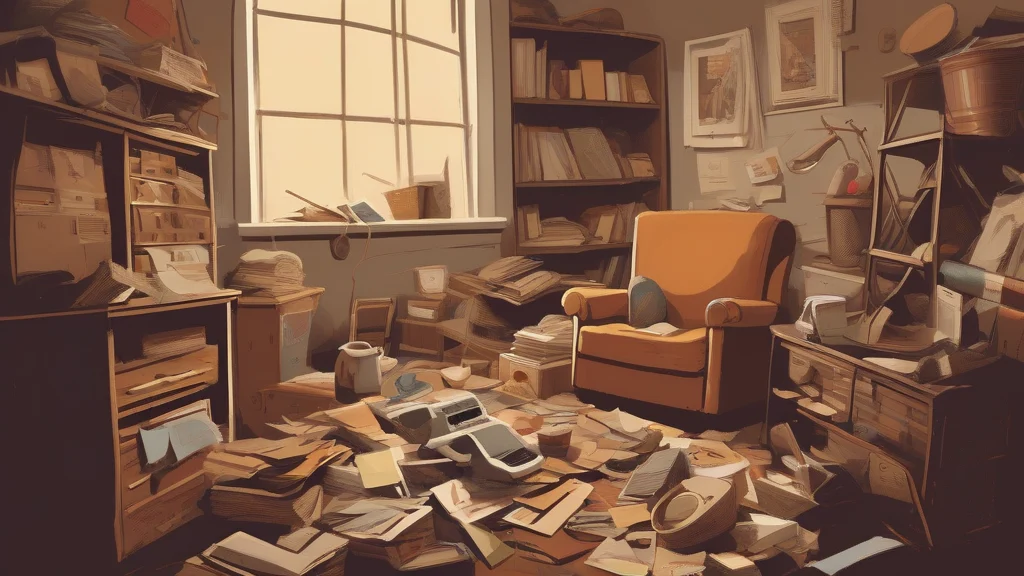
What does clutter mean?
Clutter refers to a disorderly accumulation of things — objects scattered about without organization, filling a space untidily. As a noun, it describes both the physical mess itself ('the clutter on his desk') and, more abstractly, anything excessive or distracting, from visual clutter on a webpage to mental clutter crowding one's thoughts. As a verb, to clutter means to fill a space with more things than it comfortably holds, often used with 'up.' The word carries mildly negative connotations, implying not just mess but excess and inefficiency, which explains its prominence in modern culture: minimalist design, productivity advice, and the booming industry around decluttering all position clutter as something to be eliminated. Derived forms include 'cluttered,' describing spaces overrun with things, and 'declutter,' meaning to remove the mess. Etymologically, clutter traces back to Middle English and shares Germanic roots with 'clot,' originally evoking things stuck or bunched together before settling into its modern sense of untidy abundance.
A disorderly collection of things scattered untidily about; a crowded, confused mass or state.
"She cleared away the clutter of toys from the living-room floor."
Often uncountable when referring to mess generally, but can be countable in phrases like 'a clutter of papers.'
To fill or cover a space with too many things in an untidy, disorganized way.
"Don't clutter up the hallway with shoes."
Frequently used with the particle 'up'; the derived form 'declutter' means to remove such disorder.
Rarely used in the plural; 'clutter' is almost always treated as uncountable when referring to mess in general, though 'clutters' can appear for multiple distinct disorderly heaps.
"The attic held several distinct clutters of forgotten belongings."
Before it meant a messy room, 'clutter' described blood clotting — the same Germanic root that gave us 'clot' and 'clod'.
Reviewed by Deb Chak, Editor. AI-assisted content curated by RJS Tech Solutions LLP.
Etymology of clutter
Clutter originated in Middle English as a variant related to 'clotter,' meaning to clot or congeal, and belongs to a small Germanic family of words built on the idea of lumps or masses — alongside 'clot' and 'clod.' Its early senses involved things sticking or gathering together incoherently, and by the early 17th century it had developed its modern meaning of a disorderly heap of things. The connection to clotting survives faintly in the word's sense of things bunched together rather than arranged.
Related word forms
How clutter is actually used
Common and neutral in register; the figurative sense ('digital clutter', 'clutter in a design') is well established in modern usage. The verb is often used with 'up': 'clutter up the table.' The related verb-noun pair 'declutter' became widespread in the late 20th century.
Easily confused with clutter
Clatter refers to a noisy rattling sound (as of hooves or dishes), while clutter refers to untidy, disorganized things filling a space.