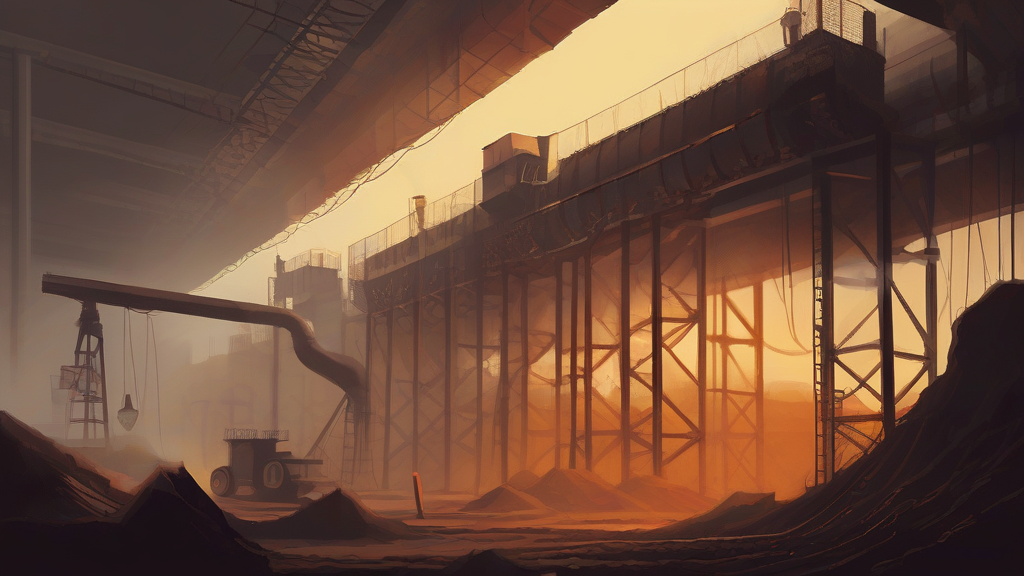
What does coalmine mean?
A coalmine is an excavation dug into the earth to extract coal, taking the form either of a deep vertical shaft with horizontal tunnels or of an open surface pit. The word combines 'coal', the combustible black sedimentary rock that fueled the Industrial Revolution, and 'mine', from ancient roots describing underground workings. Coalmines dominated the economies of Britain, the United States, Germany, and other industrializing nations throughout the nineteenth and twentieth centuries, and they remain powerful cultural symbols: associated with soot-blackened miners, company towns, union struggles, and catastrophic accidents involving gas explosions and collapses. Because conditions below ground were hazardous and invisible to those above, the phrase 'canary in the coalmine' entered everyday language as a metaphor for any small early warning of larger danger. Today, as economies shift away from fossil fuels, many former coalmines stand abandoned, repurposed as museums, heritage sites, or subjects of environmental reclamation. In British English the related word 'colliery' denotes the whole mining complex, while 'coalmine' itself is the more international and American term.
nounA coal mine is an excavation—either a deep shaft or an open pit—from which coal is extracted from the ground.
- A physical excavation (shaft, drift, or open pit) worked for the extraction of coal.
"The old coalmine on the edge of town closed after nearly a century of operation, leaving behind slag heaps and abandoned rail lines."
"The Welsh valleys are dotted with disused coalmines that once employed tens of thousands of men."
"Safety inspectors ordered the coalmine shut down after methane levels spiked dangerously underground."
Standard pluralization; used when referring to multiple mines, e.g., across a region or industry.
"Hundreds of coalmines across Appalachia have closed since the 1980s."
Miners once carried canaries into coalmines because the birds would collapse from carbon monoxide before humans could detect it — giving us the phrase 'a canary in the coalmine' for any early warning of danger.
Reviewed by Deb Chak, Editor. AI-assisted content curated by RJS Tech Solutions LLP.
Etymology of coalmine
The word coalmine is a straightforward English compound of 'coal' and 'mine'. 'Coal' derives from Old English 'cōl', meaning mineral char or charcoal, from a Proto-Germanic root also seen in German 'Kohle' and Dutch 'kool'. 'Mine' entered English from French in the medieval period, ultimately tracing back through Old French 'mine' (an underground passage or vein) to Celtic origins related to ore veins. The compound arose naturally wherever deep coal extraction developed, most prominently in Britain during the Industrial Revolution.
How coalmine is actually used
The compound is usually written solid ('coalmine') or hyphenated ('coal-mine') as a noun; as two words it often reads as the noun 'coal' modified by 'mine'. In British English, 'colliery' is the traditional term for an entire mining complex including surface buildings, while 'coalmine' refers to the excavation itself. The word carries strong connotations of industrial labor, danger, and 19th–20th century economic history.
Easily confused with coalmine
A colliery is essentially the same thing as a coalmine but is chiefly British usage; 'coalmine' is more common in American English.
A gold mine is excavated for gold ore, whereas a coalmine is excavated specifically for coal.