What does cockcrowing mean?
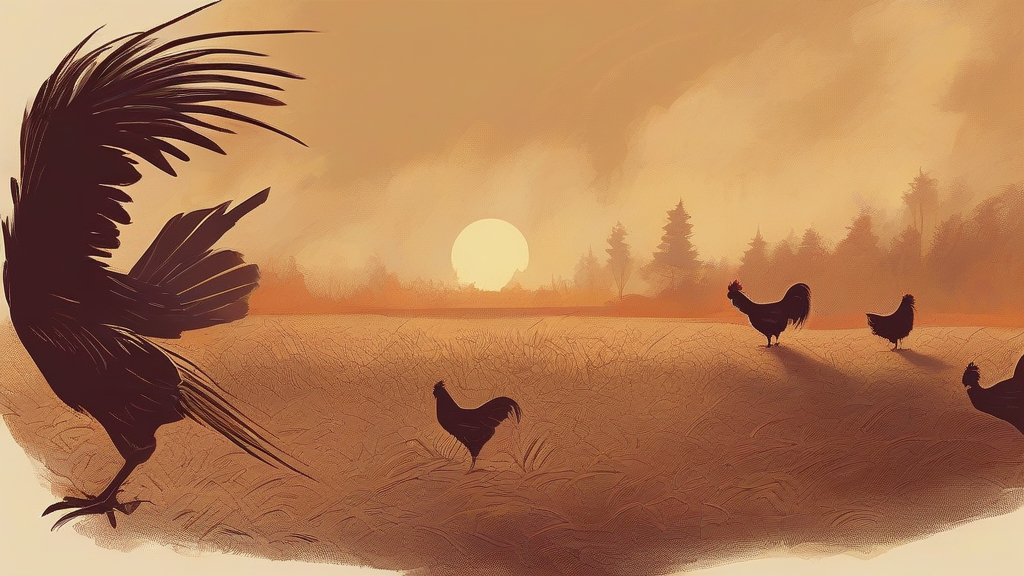
"Cockcrowing" is a noun denoting daybreak — literally, the moment a rooster crows at first light. Before mechanical timekeeping, the rooster's crow was a practical signal that the night was ending, and so the word came to stand for dawn itself. It is formed from "cock," the traditional English term for a male domestic fowl, combined with "crowing." Today the word is archaic and literary rather than part of everyday vocabulary; it survives mainly in historical writing, poetry, and descriptions of rural life, often in the fixed phrase "at cockcrowing." A related and slightly more familiar form is "cockcrow." Writers reach for it deliberately, since it evokes an older, pre-industrial world in which human routines were set by natural signals. Its antonyms are words of evening such as "nightfall" and "dusk." For readers encountering it, "cockcrowing" functions as a vivid, evocative synonym for dawn, carrying connotations of earliness, rural simplicity, and the quiet beginning of a working day.
nounThe time when a rooster crows at dawn; the break of day itself.
- The crowing of a rooster at daybreak; hence, daybreak or early morning.
"The travellers set out at cockcrowing, while mist still clung to the fields."
"The monks rose at cockcrowing for their first prayers of the day."
"By cockcrowing the fishing boats were already well out to sea."
Rarely pluralised; the word almost always appears in the singular, since it names a recurring daily moment rather than a countable object.
"He had risen at countless cockcrowings over his years on the farm."
Before alarm clocks existed, an entire household could schedule its morning around a single rooster's crow — and English honoured that moment with its own word.
Reviewed by Deb Chak, Editor. AI-assisted content curated by RJS Tech Solutions LLP.
Etymology of cockcrowing
Cockcrowing combines "cock," from Old English "cocc," meaning a male bird, with "crowing," the verbal noun of "to crow," which imitates the sound a rooster makes. The compound arose as a literal description of the bird's habitual crowing at first light and came by extension to mean daybreak itself. It belongs to a small family of English compounds built on the rooster's morning call, alongside the more common "cockcrow."
How cockcrowing is actually used
Archaic and literary; rarely used in modern speech except for stylistic effect. It appears chiefly in historical, religious, or rustic contexts, where it lends an old-fashioned or pastoral flavour. The simpler form 'cockcrow' is somewhat more common today.
Easily confused with cockcrowing
Cockcrow and cockcrowing mean essentially the same thing (daybreak), but cockcrow is the shorter and far more common form in modern usage.