What does cocked mean?
Cocked functions both as an adjective and as the past tense and past participle of the verb 'cock'. Its core meaning is 'tilted or turned up at an angle' — a person might stand with their head cocked to one side in curiosity, raise a cocked eyebrow in skepticism, or wear a hat with its brim jauntily cocked. A second, more literal sense belongs to firearms: a gun that is cocked has its hammer drawn back into position, ready to fire at the pull of the trigger. From this comes the familiar idiom 'to go off half-cocked', meaning to act impulsively before being properly prepared — a phrase that preserves the old mechanics of flintlock weapons. The word derives from 'cock', originally the male chicken, whose strutting, head-tilting posture likely inspired the sense of something angled upward or set in alert readiness. Whether describing a quizzical glance or a loaded weapon, 'cocked' consistently conveys a state of poised anticipation.
Tilted or turned up at an angle; (of a gun) having the hammer set ready for firing.
"With his hat cocked at a rakish angle, he sauntered into the saloon."
Often used attributively in phrases like 'cocked hat' or predicatively as 'with her head cocked'.
Past form of 'cock': to tilt or angle something, or to set the hammer of a gun ready for firing.
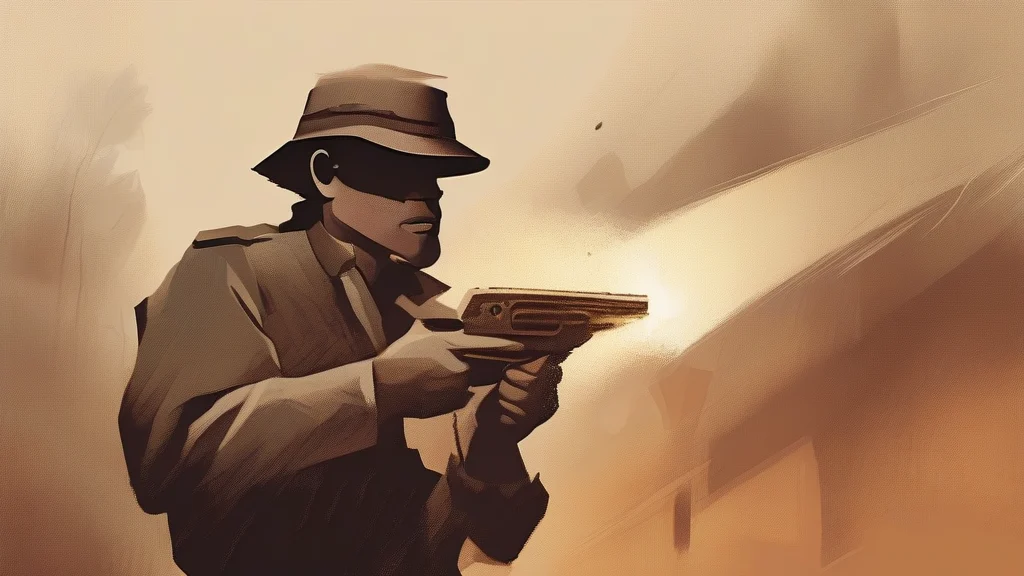
"He cocked the pistol and aimed carefully at the target."
Regularly inflected: cock, cocked, cocking.
Pulling the trigger on a gun that isn't 'cocked' does nothing at all — the word literally describes a weapon poised and waiting, like a rooster with its head raised.
Reviewed by Deb Chak, Editor. AI-assisted content curated by RJS Tech Solutions LLP.
Etymology of cocked
'Cocked' derives from the verb 'cock', which first appeared in English around the early 17th century in the sense of turning something upward or setting a gun's hammer. The underlying noun 'cock', meaning a rooster, goes back to Old English 'cocc', from a Germanic root also seen in Dutch and related languages, and is imitative or expressive rather than borrowed from Latin. The firearms sense spread widely during the age of flintlocks and survives in idioms like 'half-cocked'; related compounds sharing the same root include 'weathercock', 'cockpit', and 'shuttlecock'.
Related word forms
How cocked is actually used
In everyday speech 'cocked' most often describes a head or eyebrow tilted in curiosity, skepticism, or attention. In American usage it frequently appears in firearms contexts ('cocked and loaded'), where it carries a connotation of readiness and potential danger. The figurative idiom 'going off half-cocked' means acting rashly without proper preparation, deriving from firing a gun whose hammer was not fully set. In British English the word can carry vulgar slang associations through another sense of 'cock', so context usually disambiguates.
Easily confused with cocked
'Cocked' means tilted or readied to fire, while 'coaxed' is the past tense of coax, meaning gently persuaded.