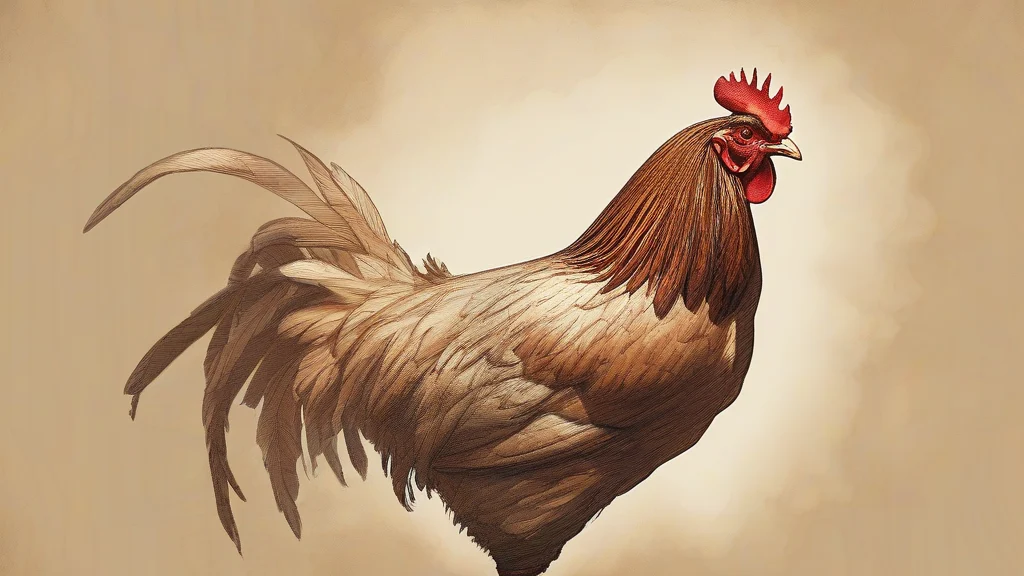
What does cock mean?
"Cock" is one of the oldest native words in English, primarily denoting an adult male domestic chicken — what American speakers almost always call a rooster. The word also has long-established technical senses: a cock is a valve or tap regulating the flow of liquid or gas (as in a stopcock), and the cock of a firearm is the piece that holds the hammer ready for firing. As a verb, to cock something means to tilt it — people cock their heads when listening curiously — or to set a gun so it is ready to shoot. The word appears in vivid idioms such as a "cock-and-bull story" (an absurd tale), being "cock of the walk" (the dominant figure in a group), and going off "half-cocked" (acting prematurely). A significant caveat governs modern usage: since roughly the seventeenth century "cock" has also served as vulgar slang for the penis, which is why American English adopted "rooster" as the everyday term for the bird and why care is needed in mixed company.
An adult male domestic chicken; a rooster.
"A black-feathered cock ruled the henhouse with loud authority."
A faucet or valve used to control the flow of liquid or gas.
"Turn off the stopcock before attempting any plumbing repairs."
The hinged striking part of a firearm that holds the firing mechanism ready.
"He drew back the cock of the pistol with a sharp click."
To tilt or angle something, especially the head, to one side; or to set a firearm's hammer in the ready position.
"The dog cocked its ears at every passing footstep."
Regular plural; applies to all noun senses (birds, valves, firearm parts). In American contexts, "roosters" is usually preferred for the bird to avoid the vulgar reading.
"The farmer kept three cocks and a dozen hens."
Until the 19th century, "cock" was simply the ordinary English word for a rooster — Americans invented "rooster" largely as a polite alternative after the word acquired its vulgar anatomical slang sense.
Reviewed by Deb Chak, Editor. AI-assisted content curated by RJS Tech Solutions LLP.
Etymology of cock
"Cock" descends directly from Old English "cocc," the ordinary word for a male bird, which is generally thought to be of imitative origin, echoing the bird's crow. It has cognates across the Germanic languages and was firmly established well before the Norman Conquest. The valve sense arose by the fifteenth century, likening the turning tap's shape or motion to a bird's beak or neck, while the firearms sense developed later. Its use as slang for the penis dates back several centuries and eventually prompted the American coinage "rooster" in the nineteenth century as a genteel substitute.
Related word forms
How cock is actually used
In British English, "cock" remains a common, unremarkable term for a rooster and appears in everyday compounds like "stopcock." In American English, "rooster" strongly predominates for the bird precisely because "cock" now carries strong vulgar connotations referring to the penis; using "cock" for the bird can therefore sound dated, odd, or unintentionally crude. The verb "to cock" (to tilt, or to ready a gun) is standard in both varieties and carries no offensive charge.
Easily confused with cock
'Cock' is the bird or a valve, while 'cocky' is an adjective meaning conceited or overly self-assured.