What does coffle mean?
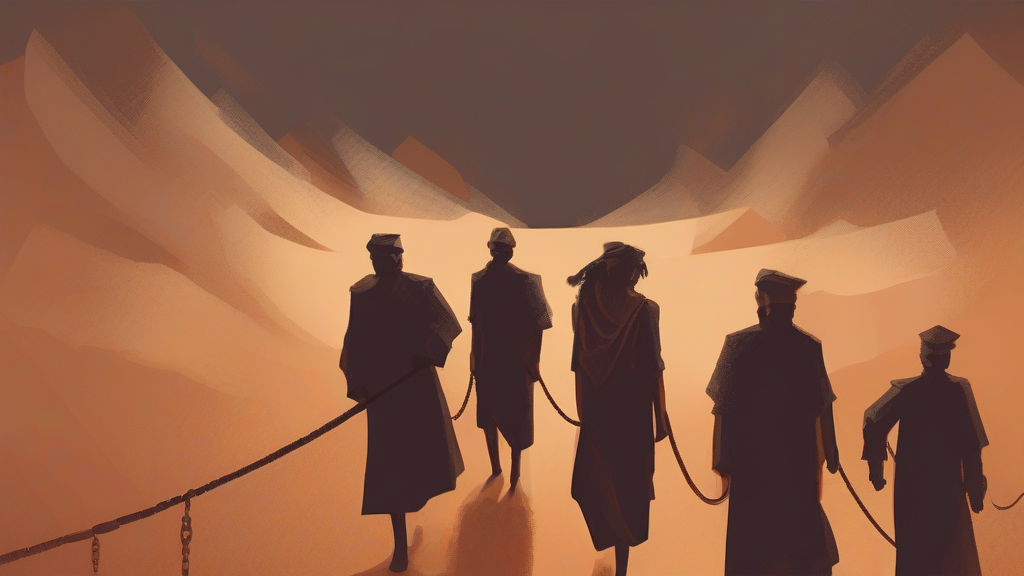
A coffle is a line of people or animals fastened together—usually by chains, ropes, or collars—and driven forward in single file. The word is most closely associated with a grim chapter of history: during the transatlantic slave trade, captured Africans were often assembled into coffles and marched overland to coastal ports for shipment. Because of this association, the term carries a somber, historically weighted connotation and appears almost exclusively in historical accounts, museum exhibits, and scholarly writing rather than casual conversation. In a broader, less charged sense, a coffle can refer to any tethered line of beasts of burden moving together, such as a string of camels or mules roped nose-to-tail across a desert. The word derives from the Arabic qāfila, meaning 'caravan,' entering English in the seventeenth century through contact with North African and Middle Eastern travel. Though uncommon today, it remains the precise, evocative term for that particular image of people or animals moving bound together in a line.
A line or train of people or animals bound together by chains or ropes and driven or led along in single file.
"The overseers formed the prisoners into a coffle before setting out at dawn."
To fasten people or animals into a chain or line and drive them along in single file.
"They coffled the mules together for the mountain crossing."
Regular plural; used when referring to multiple such lines, e.g. in historical accounts of several marching columns.
"Historians have documented numerous coffles that crossed the interior on their way to the coast."
'Coffle' entered English through one of history's darkest chapters — the transatlantic slave trade — as the word for the chained lines of captives force-marched to coastal ships.
Reviewed by Deb Chak, Editor. AI-assisted content curated by RJS Tech Solutions LLP.
Etymology of coffle
Coffle comes from the Arabic qāfila, meaning 'caravan' or 'traveling company', which passed into European languages through North African and Levantine trade routes; a related form, cafila, was used in French and Spanish. The word entered English in the seventeenth century, initially describing lines of traveling animals or merchants. Its most enduring and sobering usage developed in connection with the transatlantic slave trade, where it became the standard term for chained columns of captives marched to coastal shipping points.
How coffle is actually used
The word carries heavy historical connotations because of its association with the transatlantic slave trade and other episodes of forced captivity; it appears chiefly in historical writing and is rare in everyday speech.
Easily confused with coffle
A caravan is a group of travelers or pack animals journeying together voluntarily, whereas a coffle specifically implies people or animals bound together by chains or ropes.