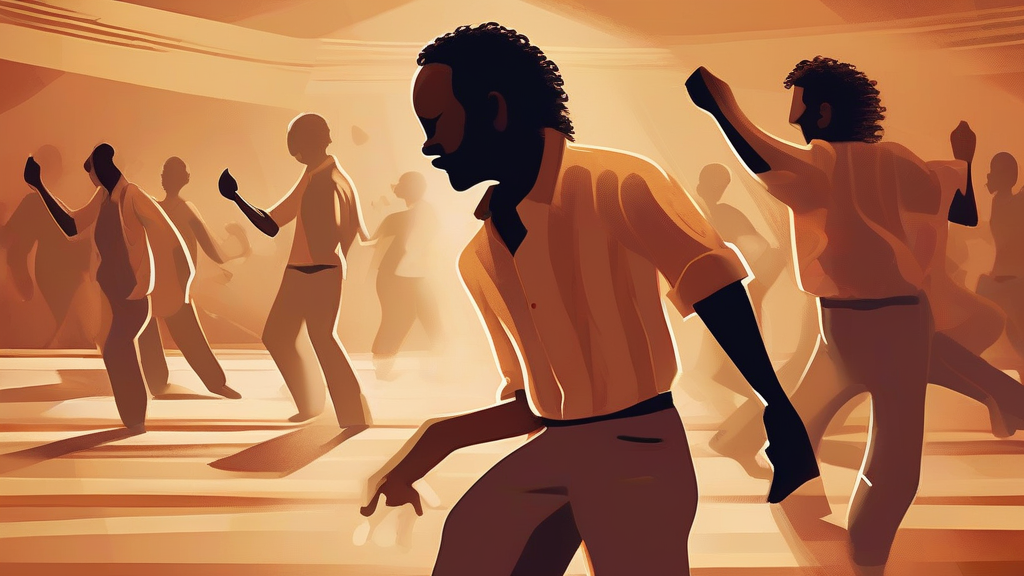
What does congaing mean?
Congaing is the present participle of the verb "conga," meaning to perform the conga — a lively Latin American dance in which participants form a single-file line, follow a leader, and move forward with a repeating pattern of three shuffling steps and a distinctive kick, usually to driving Afro-Cuban percussion. The word carries an unmistakably festive connotation: it surfaces in accounts of weddings, holiday parties, cruise ships, and celebrations, where a conga line often snakes spontaneously through a room, sweeping up reluctant bystanders as it goes. Grammatically, congaing functions only within progressive verb phrases such as "was congaing" or "went congaing," never as a standalone action. The term derives from Cuban Spanish, which borrowed the name of the dance from the Congo region of Africa, giving this playful party word a genuinely global pedigree. Though informal, it is well established and instantly understood wherever the dance itself is known.
verbCongaing is the present participle of the verb "to conga": to perform the conga, a Latin American ballroom and party dance in which dancers move in a single-file line, following a leader with three shuffle steps followed by a kick.
- To dance the conga, either solo-style in place or as part of a snaking conga line at parties, weddings, and celebrations.
"The wedding guests went congaing around the reception hall long past midnight."
"Guests spilled out of the ballroom, congaing through the hotel lobby behind a trumpet-playing uncle."
"By the final chorus, half the office was congaing between the desks."
When you're congaing, you're literally tracing your steps back to the Congo — the dance's name traveled from Central Africa through Cuban Spanish before taking over parties worldwide.
Reviewed by Deb Chak, Editor. AI-assisted content curated by RJS Tech Solutions LLP.
Etymology of congaing
The verb "conga" comes from Cuban Spanish "conga," the name of both an Afro-Cuban dance-music style and its characteristic drum, which was itself derived from the Kongo people and region of Central Africa whose cultural traditions shaped much of Cuban music. The word entered English during the international Latin-dance booms of the twentieth century, when Cuban dances such as the rumba and mambo spread worldwide. The participial form "congaing" follows standard English inflection of borrowed verbs.
Related word forms
How congaing is actually used
Informal and festive in register; the word appears almost exclusively in descriptions of parties, weddings, cruises, and celebrations. It is always used in progressive constructions (was congaing, kept congaing) rather than standing alone.
Easily confused with congaing
"Conga" is the noun naming the dance and its music, while "congaing" is the verb form describing the act of dancing it.
"Congealing" means solidifying or thickening (as liquids do), whereas "congaing" means dancing the conga — despite a superficial visual similarity between the spellings.