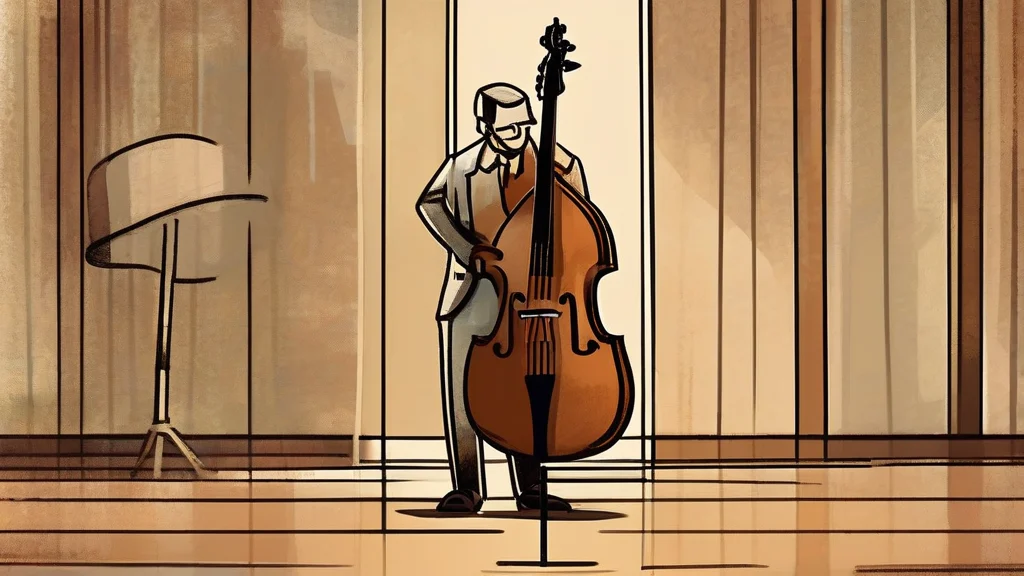
What does contrabassist mean?
A contrabassist is a musician who performs on the double bass, the largest member of the violin family and the lowest-pitched stringed instrument commonly found in Western music. Standing well over six feet tall, the instrument is typically played either upright, supported by an endpin, using a bow in classical settings, or plucked pizzicato in jazz and popular styles. The term 'contrabassist' carries a slightly more precise and formal register than the broader 'bassist,' which may also refer to a bass-guitar player, so it is favored in orchestral programmes, conservatory contexts, and professional jazz writing when clarity matters. Skilled contrabassists are prized for anchoring an ensemble's harmonic foundation and rhythmic pulse, and notable figures such as Charles Mingus and Ray Brown have elevated the role to one of genuine expressive prominence rather than mere accompaniment.
nounA contrabassist is a musician who plays the double bass (also called the contrabass), the largest and lowest-pitched instrument of the violin family, in classical orchestras, jazz ensembles, or other musical settings.
- A musician who plays the double bass (contrabass), whether bowed or plucked, in orchestral, jazz, chamber, or popular music settings.
"The orchestra's principal contrabassist anchored the low strings with a rich, resonant tone."
"After decades as a solo cellist, she reinvented herself as a contrabassist with a leading jazz quartet."
"The conservatory admitted only two contrabassists that year, both of whom had studied under renowned European masters."
Standard plural; most orchestras employ several, referred to collectively as the 'double bass section.'
"The symphony's eight contrabassists formed a powerful foundation beneath the full string section."
The contrabassist plays an instrument so tall it can stand over six feet — often taller than the musician themselves.
Reviewed by Deb Chak, Editor. AI-assisted content curated by RJS Tech Solutions LLP.
Etymology of contrabassist
The word 'contrabassist' derives from 'contrabass,' itself borrowed from Italian 'contrabbasso,' meaning 'against' or 'below' the bass — indicating an instrument sounding lower than the standard bass range. The prefix 'contra-' comes from Latin 'contra,' meaning 'opposite' or 'against,' a root it shares with words like 'contralto,' 'contraband,' and 'counterpoint.' As the double bass became established in orchestras from the Baroque era onward, musicians who specialized in it came to be described by this derived agent noun, paralleling formations such as 'cellist' for cello players.
Related word forms
How contrabassist is actually used
The term is used primarily in formal, classical, and jazz contexts where precision about which bass instrument is meant matters. In casual speech, 'bassist' is far more common but is ambiguous between double-bass players and bass-guitarists; 'contrabassist' resolves that ambiguity.
Easily confused with contrabassist
A bass guitarist plays an electric fretted instrument held horizontally, while a contrabassist plays the large acoustic double bass played upright or with a bow.