What does contrabassoon mean?
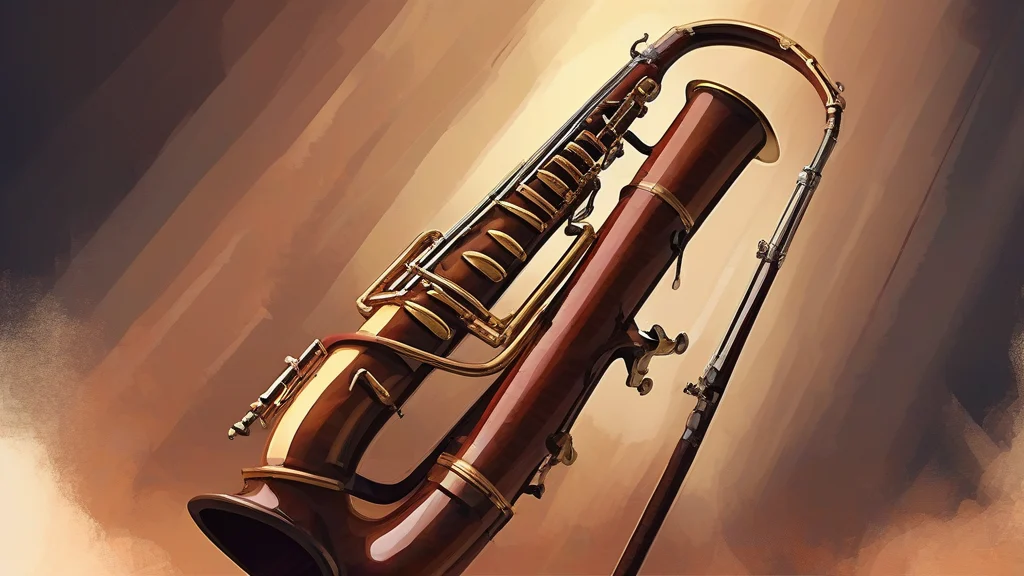
The contrabassoon, sometimes called the double bassoon, is the largest and lowest-pitched member of the woodwind family. A double-reed instrument built from roughly eighteen feet of conical tubing folded back on itself, it sounds one octave below the bassoon and reaches notes at the very bottom of the audible range. Its deep, resonant tone serves chiefly to reinforce the bass line of large orchestral works, where composers such as Haydn, Beethoven, Mahler, and Ravel have written notable parts for it. Because its lowest notes are felt almost as much as heard, the instrument lends weight and gravity rather than melodic prominence. Played by a seated performer who supports the heavy body with a strap or end pin, the contrabassoon appears mainly in symphony orchestras and large concert bands, and remains a specialized instrument even among professional woodwind players, most of whom train first on the standard bassoon.
nounThe contrabassoon is the largest and lowest-pitched member of the woodwind family, a double-reed instrument sounding an octave below the bassoon.
- The largest and lowest-sounding instrument of the woodwind section, a double-reed instrument pitched an octave below the bassoon; also the musician who plays it.
"The contrabassoon rumbled beneath the strings in the opening of Beethoven's Fifth Symphony."
"The orchestra's contrabassoon doubled the cello line, adding a dark foundation to the texture."
"She switched from bassoon to contrabassoon for the finale of the symphony."
Standard plural; typically refers to multiple instruments rather than players.
"The warehouse held two contrabassoons awaiting repair."
At over nine feet of folded tubing, the contrabassoon can produce notes lower than the human ear can clearly register — you feel them more than hear them.
Reviewed by Deb Chak, Editor. AI-assisted content curated by RJS Tech Solutions LLP.
Etymology of contrabassoon
The word contrabassoon derives from Italian 'contrabasso', meaning 'double bass', combined with 'fagotto', the Italian name for the bassoon — hence 'contra-fagotto'. The instrument itself emerged in the late 16th and early 17th centuries as builders sought to extend the bassoon's range downward, with early examples attributed to makers such as Hans Schreiber in Germany. The English term 'contrabassoon' reflects this Italian lineage, sharing its root 'basso' (low) with cognates like bass, basso, and bassoon.
How contrabassoon is actually used
Primarily used in orchestral and band contexts; rarely encountered outside music terminology. The player is often referred to simply by the instrument name, e.g. 'the contrabassoon' or 'the contra'. In informal orchestral slang it may be shortened to 'contra'.
Easily confused with contrabassoon
The bassoon is the standard tenor-range double-reed instrument, while the contrabassoon is a larger relative that plays an octave lower.
The double bass is the lowest-pitched string instrument, whereas the contrabassoon achieves the deepest woodwind range as a double-reed wind instrument.