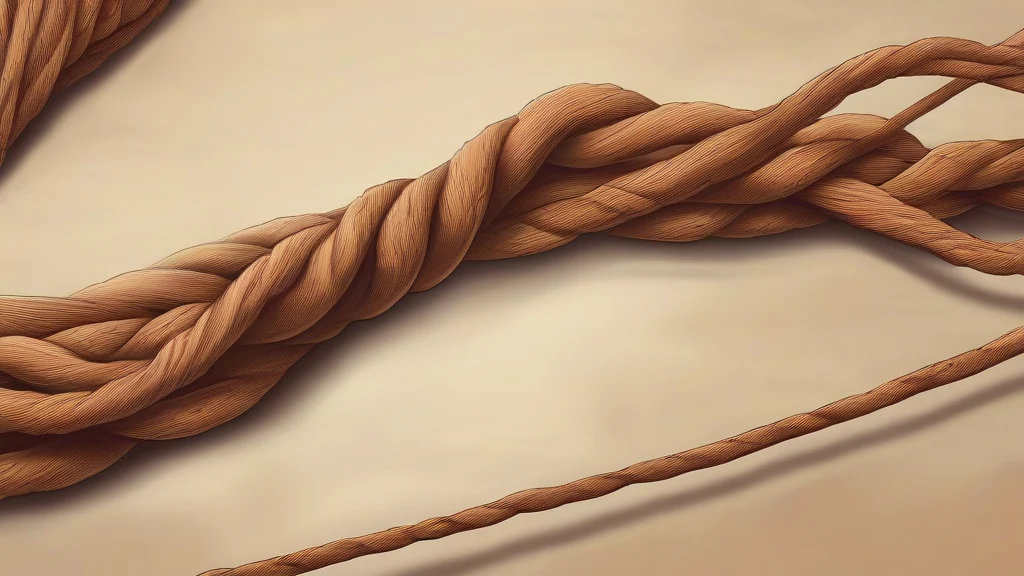
What does corded mean?
"Corded" is an adjective describing something tied, bound, or furnished with cords, and by extension anything marked by a rope-like or ribbed texture. It applies literally to objects secured with string or cable — a corded bundle, a corded window blind — and to devices connected by a physical wire, such as a corded telephone or power tool, where it contrasts with "cordless." In textiles, corded fabrics feature raised ribs or ridges running along their surface, as in certain weaves and trimmings. Applied to the body, "corded" describes muscles that stand out tautly beneath the skin, evoking strength and strain. The word derives from "cord," ultimately from Latin "chorda," meaning string or gut, which also gives us "chord" and "accordion." Whether describing a package, a fabric, or a flexed forearm, "corded" consistently suggests the firmness and linear character of twisted fiber.
Tied, bound, or fastened with a cord or cords.
"The bundles were corded tightly before being loaded onto the cart."
Having a ribbed or rope-like surface or texture, as of fabric or muscle.
"He gripped the oar with corded hands."
Often used figuratively of muscles to suggest visible strength or tension.
Past tense and past participle of "cord": to bind or furnish with a cord.
"The workers corded the firewood into neat stacks."
Chiefly technical or craft usage.
Your grandmother's "corded" telephone and a bodybuilder's "corded" forearms share the same ancient Latin root for rope.
Reviewed by Deb Chak, Editor. AI-assisted content curated by RJS Tech Solutions LLP.
Etymology of corded
"Corded" derives from "cord," meaning a length of twisted string or rope, plus the adjectival suffix "-ed." The noun "cord" entered Middle English from Old French "corde," which came from Latin "chorda," itself borrowed from Greek "khorde," meaning the gut of an animal used as a string. This same Latin root produced "chord" in its musical sense and underlies words such as "accordion" and "harpsichord." The adjective has been in use since at least the early modern period, developing both its literal binding sense and its figurative textured-muscle sense over time.
Related word forms
How corded is actually used
Mostly neutral in register. The textile sense is common in fashion and upholstery contexts, while the muscular sense often carries a connotation of strength or physical exertion. As the past tense of the verb "cord," it appears mainly in technical or craft contexts.
Easily confused with corded
"Chorded" relates to musical chords or geometric chords, while "corded" relates to cords — strings, ropes, or cables.