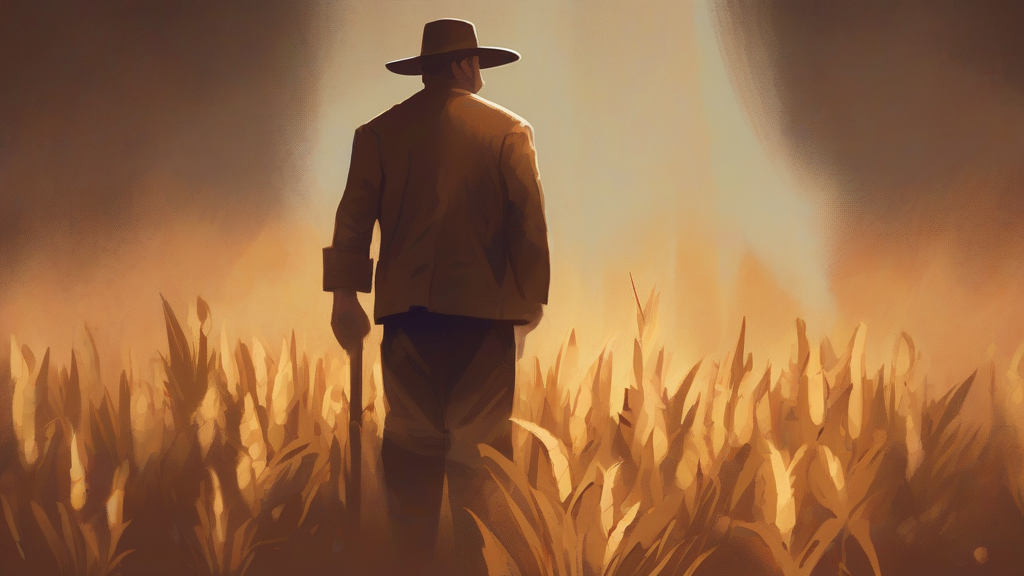
What does cornhusker mean?
A cornhusker is, literally, a person — or historically, a machine — whose task is to remove the husks, the tough outer leaves, from ears of corn. Before mechanization, husking corn by hand was a laborious seasonal chore on American farms, making the cornhusker a familiar rural figure of the nineteenth and early twentieth centuries. Today, however, the word is far better known as a proud regional nickname: Nebraska is popularly called the "Cornhusker State," its residents are known as Cornhuskers, and the University of Nebraska's athletic teams compete under the same name, inspiring fierce loyalty among fans. The word thus carries strong connotations of the American Midwest, agricultural heritage, hard work, and community identity. Whether encountered on a farm or at a football stadium, "cornhusker" is a distinctly American term rooted in the country's farming past but kept vividly alive through sport and state pride.
nounA person or machine that removes the husks (outer leaves) from ears of corn; also used as a nickname for a native or resident of Nebraska.
- A person or machine that strips the husks from ears of corn.
- A nickname for a native or resident of Nebraska, or for the University of Nebraska's athletes and fans.
"Every autumn, the elderly cornhusker worked his way down the rows, stripping the dry papery husks by hand."
"The old cornhusker could strip a dozen ears in the time it took the machine to warm up."
"As a lifelong Cornhusker, she rarely missed a Nebraska football game on Saturdays."
The plural follows regular English noun pluralization; when used as the Nebraska nickname, the plural form (e.g., "the Cornhuskers") refers collectively to residents or team members.
"Thousands of Cornhuskers filled the stadium on game day."
Nebraskans are nicknamed after a farm chore — and they wear it proudly as the "Cornhusker State."
Reviewed by Deb Chak, Editor. AI-assisted content curated by RJS Tech Solutions LLP.
Etymology of cornhusker
Cornhusker is a straightforward English compound formed from "corn," the cereal grain native to the Americas that became central to North American agriculture, and "husker," an agent noun derived from "husk," meaning to remove the outer covering of a seed or grain. Both elements are long established in English, with "corn" and "husk" dating back centuries in the language. The compound emerged in nineteenth-century America, where husking corn by hand was a common farm task, and it rose to lasting prominence when it was adopted as the official nickname of Nebraska and of the University of Nebraska's teams in the late nineteenth century.
Related word forms
How cornhusker is actually used
In modern usage, "Cornhusker" is far more often encountered capitalized as the well-known sobriquet for Nebraskans (Nebraska is officially the "Cornhusker State") and for the University of Nebraska's sports teams than as a term for an actual worker who husks corn, which is now largely historical given mechanized farming.
Easily confused with cornhusker
"Husker" is the shorter general term for someone or something that removes husks, while "cornhusker" specifies corn and is best known as the nickname for Nebraskans and the University of Nebraska's athletic teams.