What does cornhusking mean?
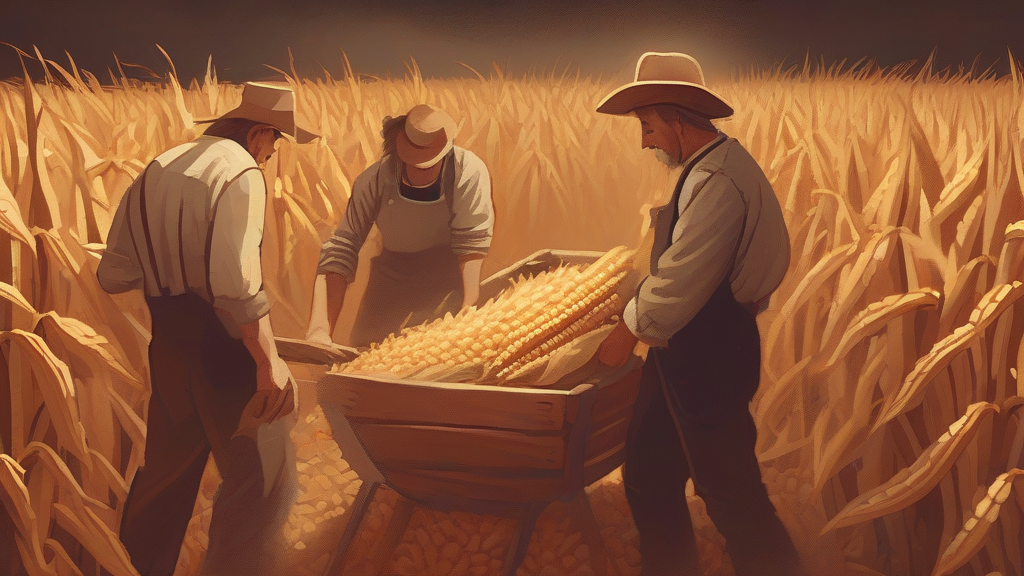
Cornhusking is the act of stripping away the dry outer leaves, or husks, from ears of corn after harvest. The word is chiefly American and evokes a distinctive piece of rural history: in the eighteenth and nineteenth centuries, before mechanization made the task obsolete, communities gathered for cornhusking bees, festive working parties in which neighbors cleared whole crops of corn together, often competing for speed and celebrating with music, food, and dancing. By long custom, discovering a rare red ear of corn entitled the finder to a kiss or a prize, adding an element of romance to the labor. Today the word survives mainly in historical writing, folklore, and local festivals that reenact the tradition, where it connotes warmth, community spirit, and nostalgia for America's agricultural past.
nounThe act or process of stripping the outer leaves (husks) from ears of corn; also, in American rural tradition, a social gathering at which people husk corn together, often as a festive event known as a cornhusking bee.
- The act of removing the husks from ears of corn.
- A traditional rural American social event or party centered on husking large quantities of corn together.
"The whole town turned out for the autumn cornhusking at the Grange hall."
"After the harvest, neighbors gathered for an evening of cornhusking and cider."
"She won first prize in the county fair's cornhusking contest."
Rarely pluralized; used mainly when referring to multiple such events.
"The museum's records mention cornhuskings held each fall through the 1920s."
In old-time cornhusking bees, finding a red ear of corn earned you the right to kiss your neighbor — making farm chores surprisingly competitive.
Reviewed by Deb Chak, Editor. AI-assisted content curated by RJS Tech Solutions LLP.
Etymology of cornhusking
Cornhusking is a compound of two native Germanic elements: 'corn,' from Old English 'corn' (grain), and 'husk,' from Middle English 'husk,' likely related to Old English 'hūs' in the sense of a covering or sheath. The compound arose in colonial North America, where husking was a central task of the maize harvest, and it became attached to the communal 'husking bees' of New England and the frontier. Its closest relatives are other compounds built on 'corn,' such as 'cornfield' and 'corncrib,' and derivatives like 'kernel,' itself a diminutive development related to 'corn.'
Related word forms
How cornhusking is actually used
Chiefly North American and associated with rural, especially Midwestern, life; the term carries nostalgic, folksy connotations and is largely historical today, though cornhusking events survive as festival activities.
Easily confused with cornhusking
Shucking refers to removing husks or shells generally (as with oysters or peanuts), while cornhusking specifically means stripping the husks from corn.