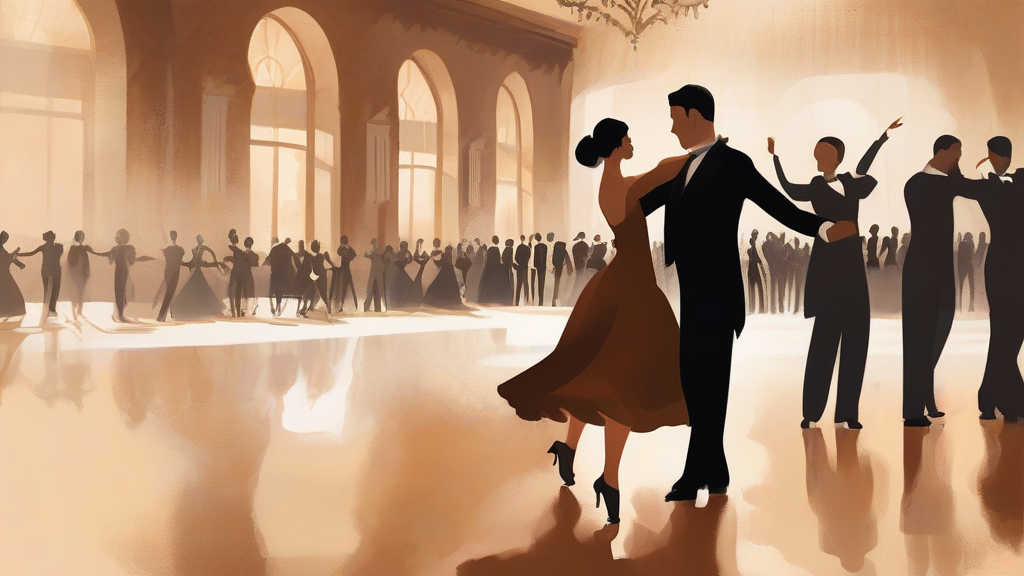
What does cotillon mean?
A cotillon is a lively ballroom dance that originated in France in the early eighteenth century, performed in triple time by couples arranged in a square or circle who exchanged partners through a series of intricate figures. Its name derives from the French word for petticoat, a nod to the glimpses of undergarments that the whirling skirts were thought to afford. By the nineteenth century the term had broadened, especially in the United States, to describe the formal ball itself — most notably the debutante balls at which young women from prominent families were presented into society, a tradition that survives in some American cities today. The spelling varies between 'cotillon' and 'cotillion', with the double-l form more prevalent in American usage. Today the word carries a distinctly old-world elegance, evoking candlelit ballrooms, white gloves, and the rigid etiquette of a vanished social order.
A lively French ballroom dance in triple time, danced by couples in square formation with frequent partner exchanges, fashionable from the early 18th century through the 19th century.
"The evening's festivities opened with a spirited cotillon led by the master of ceremonies."
Also spelled 'cotillion'; both forms are standard, with the latter more common in American English.
A formal ball at which debutantes are presented to society, particularly in certain regions of the United States.
"She spent months preparing for her presentation at the winter cotillon."
The standard plural simply adds -s; the same plural serves both spellings ('cotillons'/'cotillions').
"The city's social calendar once revolved around a season of lavish cotillons."
The word for this elegant 18th-century dance literally comes from the French for 'petticoat' — because the swishing skirts were said to reveal them.
Reviewed by Deb Chak, Editor. AI-assisted content curated by RJS Tech Solutions LLP.
Etymology of cotillon
Cotillon entered English in the early eighteenth century, borrowed directly from the French word of the same spelling. The French term literally means 'petticoat' or 'underskirt', formed as a diminutive of 'cotte' (a garment or tunic), which itself traces back through Old French to Latin. It was applied humorously to the new dance, supposedly because its figures revealed the dancers' petticoats. English adopted both the dance name and, later, the extended sense of a formal ball, alongside the variant spelling 'cotillion'.
How cotillon is actually used
Both spellings — 'cotillon' and 'cotillion' — are accepted, with 'cotillion' somewhat more common in American English. The word has a distinctly old-fashioned, formal connotation today, evoking 19th-century high society rather than contemporary social dancing. The second sense (a debutante ball) is chiefly North American.
Easily confused with cotillon
Cotton is a soft fibrous material used to make textiles, whereas a cotillon is a dance or formal ball.
"Cotillion" is merely an alternative spelling of "cotillon", referring to exactly the same dance or ball.