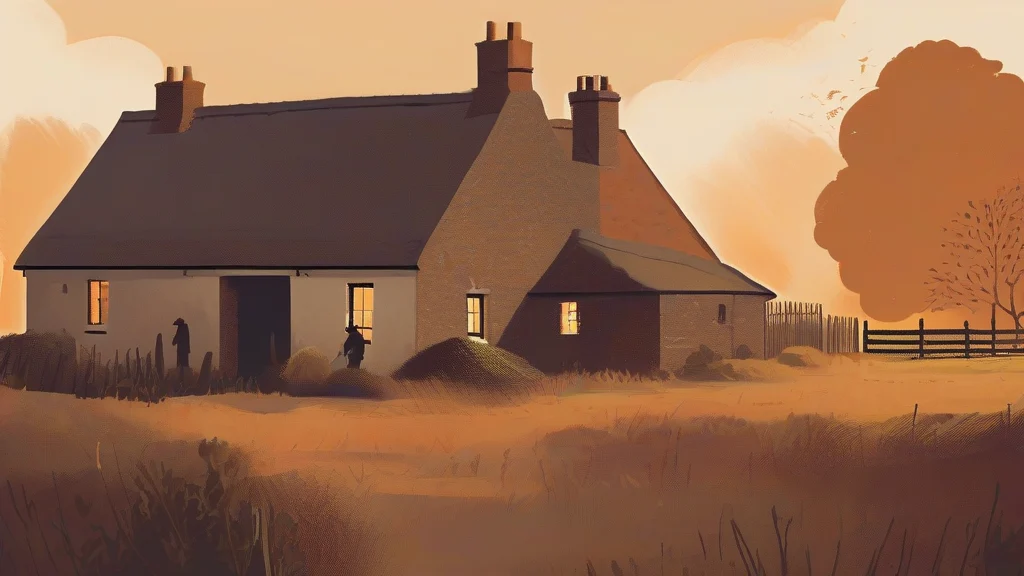
What does cottier mean?
A cottier was a rural labourer occupying a cottage with a small patch of land attached, whose rent was commonly paid through work performed on the landlord's own fields rather than in money. The word is inseparable from Irish agrarian history: during the eighteenth and early nineteenth centuries, cottiers formed the poorest stratum of the countryside above only paupers, subsisting largely on potatoes grown on their minute holdings. The collapse of this system after the Great Famine of the 1840s left "cottier" as a term of historical record rather than everyday speech. Today it appears mainly in scholarly writing about land tenure, estate papers, and period literature. Related terms include crofter, its Scottish counterpart, and smallholder. Because the word evokes extreme rural poverty and dependence, using it requires awareness of its historical weight — it names not merely a dwelling arrangement but an entire vanished social order built around the great estates.
nounA cottier is a farm labourer who occupies a cottage on an estate and pays rent for the land attached to it, typically in the form of labour or produce rather than cash. The term is chiefly associated with Ireland, where cottiers formed the lowest tier of rural society in the eighteenth and nineteenth centuries.
- (Historical) In Ireland and parts of Britain, a peasant holding a small cottage with just enough land to feed himself and his family, paying rent by labour on the landlord's farm.
- More broadly, a person living in a cottage, especially one belonging to a landed estate.
"The estate's records listed every cottier who held a plot of land behind his cabin."
"By 1845, most Irish cottiers depended almost entirely on the potato crop grown on their tiny plots."
"The novel portrays a cottier family eking out a living on the edge of the great estate."
Regular plural; typically used when discussing the class collectively, as in "the cottiers of Munster."
"Thousands of cottiers faced eviction when the estates were reorganized."
In pre-famine Ireland, the cottier sat at the very bottom of the rural ladder — so poor that his rent was often paid in a day's digging of his landlord's fields.
Reviewed by Deb Chak, Editor. AI-assisted content curated by RJS Tech Solutions LLP.
Etymology of cottier
The word "cottier" derives ultimately from the noun "cot," meaning a humble dwelling, via Old English "cote," which itself traces back to Proto-Germanic roots denoting a hut or shelter. It entered standard English usage in the seventeenth century, particularly through descriptions of the Anglo-Irish countryside, where the "cottier system" became a defining feature of rural life. Its cognate "coterie" travelled a different route, entering English from French with a more refined social sense, while "cottage" shares the same Germanic root for a modest dwelling.
How cottier is actually used
"Cottier" is now almost exclusively historical or literary, used when discussing agrarian history — particularly pre-famine Irish social structure. It carries connotations of poverty, dependency, and the harsh conditions of the old landlord-tenant system; it should not be casually applied to modern tenants or homeowners.
Easily confused with cottier
A 'coterie' is a small exclusive circle of people sharing interests, while a 'cottier' was historically a poor tenant farm labourer; the two words are near-homophones but entirely unrelated in meaning.