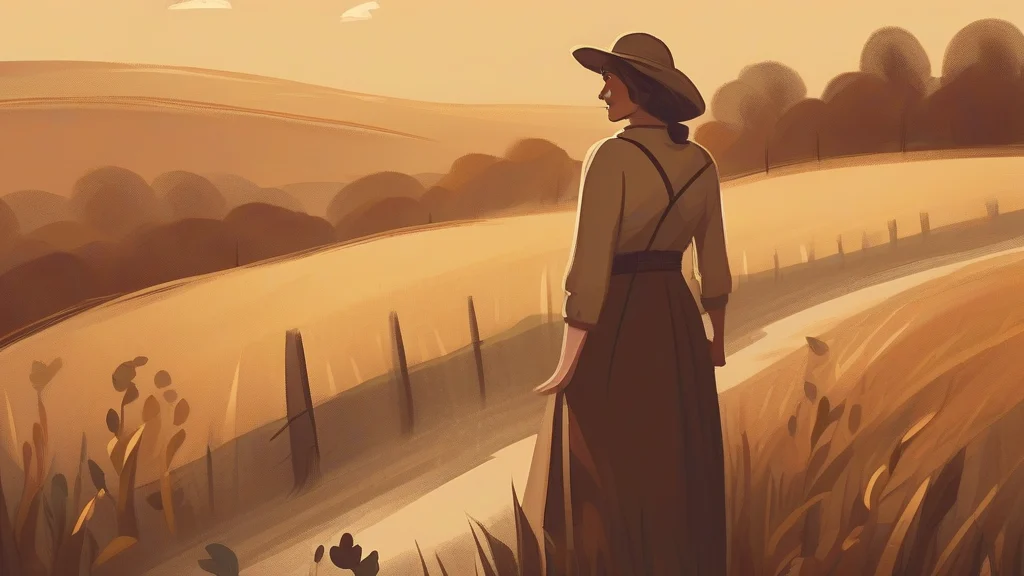
What does countrywoman mean?
A countrywoman is a woman who lives in the countryside or who belongs to a particular country by birth or nationality. The word has two related senses: in its literal, geographic use it describes a woman rooted in rural life — someone at home on farms, in villages, or among open landscapes — while in its civic sense it identifies a woman as one's compatriot, most commonly in the phrase "a fellow countrywoman." The term carries a distinctly warm, even nostalgic connotation in British English, evoking self-sufficiency, practicality, and closeness to nature, and it appears frequently in literature and journalism that celebrate rural life. Its male counterpart is countryman, and the two words share a common structure: the noun country combined with a gendered suffix. Though somewhat literary in register, countrywoman remains current wherever writers wish to emphasize a woman's rural identity or national kinship with elegance and economy.
nounA woman who lives in the countryside, or a woman who was born in or comes from a particular country.
- A woman who lives in or comes from the countryside (rural sense).
- A woman born in or belonging to a particular country; a female compatriot.
"She spoke with the easy warmth of a countrywoman, equally at home among hedgerows and harvest fields."
"As a lifelong countrywoman, she knew every footpath and stream within ten miles of her village."
"She greeted the visiting delegate warmly as a fellow countrywoman."
Standard irregular-style plural formed by replacing '-man' with '-men', mirroring countryman → countrymen.
"Her essays gave voice to generations of countrywomen whose labor sustained rural England."
"Fellow countrywoman" has long been a phrase of solidarity — used by queens, reformers, and writers to claim kinship with women of their nation or their soil.
Reviewed by Deb Chak, Editor. AI-assisted content curated by RJS Tech Solutions LLP.
Etymology of countrywoman
Countrywoman is formed within English from the noun country, which derives via Old French contree from Latin contrata, meaning 'land lying opposite' or 'the land spread out before one,' ultimately from Latin contra ('against, opposite'). The compound follows the pattern of older words like countryman, combining country with a gender-specific agentive element. The word has been in English use since roughly the early modern period, alongside its masculine counterpart, and cognates such as counterpart reflect the same Latin root contra.
Related word forms
How countrywoman is actually used
The plural is countrywomen. The word carries a warm, sometimes affectionate connotation when describing rural life, but can sound slightly old-fashioned or literary compared to neutral alternatives like 'woman from the countryside.' The 'compatriot' sense is often used in the fixed phrase 'fellow countrywoman.'
Easily confused with countrywoman
Countryman is the male equivalent of countrywoman; both mean a person from the countryside or from one's own country.
Countryside refers to rural land and scenery itself, not a woman who lives there.