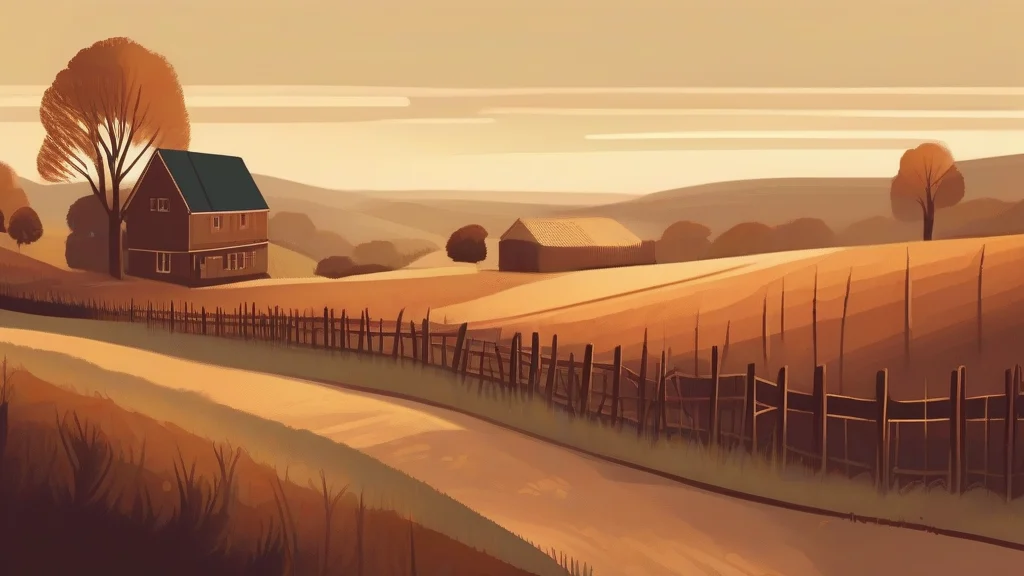
What does countryside mean?
Countryside refers to the land that lies beyond towns and cities: fields, farms, woodland, hills, and villages regarded as a whole rather than as specific places. Used almost always with the definite article ('the countryside'), it denotes both a physical territory and the scenic, pastoral qualities associated with rural life. The word carries warm connotations of peace, tradition, natural beauty, and escape from urban pressure, making it a fixture in travel writing, politics (as in debates over protecting the countryside), and everyday conversation about holidays or retirement plans. It is especially resonant in British English, where the countryside is tied to ideas of national heritage, though the word is well understood throughout the English-speaking world. Derived from 'country' in its older sense of a region or tract of land, it emerged in the seventeenth century as urban life grew distinct enough from rural life to need a word for what lay outside the city walls.
nounThe land of a region away from towns and cities, typically consisting of fields, woods, hills, and farmland; rural scenery and terrain.
- Rural land away from cities and towns — fields, hills, woods, and farmland considered collectively.
- (Less commonly) the characteristic scenery or landscape of such a region.
"They spent the weekend hiking through the rolling countryside of Yorkshire."
"After years in London, she longed for the quiet of the countryside."
"The train wound through patchwork countryside dotted with sheep."
Rare; used mainly when comparing the landscapes of different regions.
"The documentary contrasts the countrysides of Provence and Tuscany."
The word countryside didn't exist until the 17th century — before then, most people simply called it 'the country,' since there was little else to contrast it with.
Reviewed by Deb Chak, Editor. AI-assisted content curated by RJS Tech Solutions LLP.
Etymology of countryside
Countryside derives from 'country,' which entered Middle English from Old French 'contree,' itself from Latin 'contra' meaning 'opposite' or 'facing' — land lying opposite or spread before one, hence a defined territory. In its earliest uses, 'country' simply meant a particular region or tract of land. As towns expanded and the contrast between urban and rural life sharpened, 'countryside' emerged as a compound in the early seventeenth century to denote rural land collectively. It shares this Latin root with words such as 'county,' 'count,' and 'contrary.'
How countryside is actually used
Countryside is a collective noun treated as uncountable in the singular ('the countryside'), though it can take a plural when referring to multiple regions. It carries strongly pastoral, often nostalgic connotations in British culture especially, where phrases like 'the green countryside' evoke national identity. It is standard in both formal and informal contexts but is more prominent in British usage than American, where terms like 'rural areas' or 'the country' are also common.
Easily confused with countryside
Country can mean a nation, a rural area, or the countryside itself as an adjective (e.g. 'country lane'), whereas countryside refers specifically to rural land and scenery.