What does cowpuncher mean?
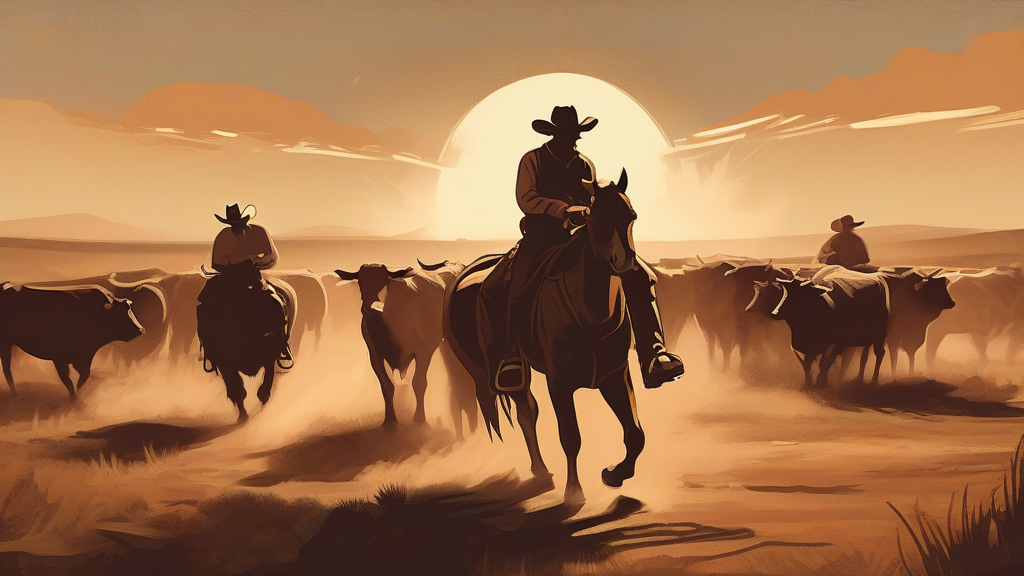
A cowpuncher is a cowboy — a worker who rides horseback to herd, drive, and tend cattle, particularly on the ranches and long trail drives of the American West. The name arose in the United States during the great cattle-drive era of the late nineteenth century, when hands were said to 'punch' cattle, meaning to prod and push the herd along the trail; the verb 'to punch cows' simply described the daily work of keeping the animals moving. The word is therefore closely tied to a specific time and place, evoking wide-open ranges, chuck wagons, and dusty trails rather than modern feedlot operations. Today it survives mainly in Western fiction, historical accounts, and regional speech, where it lends an authentic, slightly old-fashioned flavor. While 'cowboy' has become the standard term worldwide, 'cowpuncher' remains a colorful American synonym that instantly signals the rough, independent world of the open-range cattle industry.
nounA person employed to herd and manage cattle on horseback, especially on ranches in the American West; a cowboy.
- A cowboy; a worker who herds and tends cattle on horseback in the American West.
"The old cowpuncher spent forty years driving herds across the Montana range."
"As a young cowpuncher he learned to read the weather before the storms rolled off the Rockies."
"The novel paints its cowpunchers as restless drifters moving from one dusty railhead to the next."
Standard plural, formed regularly with -s.
"The saloon filled with tired cowpunchers at the end of the drive."
A cowpuncher never actually punched anyone — the name comes from 'punching' cattle, that is, prodding them along the trail.
Reviewed by Deb Chak, Editor. AI-assisted content curated by RJS Tech Solutions LLP.
Etymology of cowpuncher
Cowpuncher is an American coinage of the late nineteenth century, formed from 'cow' plus 'puncher,' an agent noun based on the verb 'punch.' In Western slang, to 'punch' cattle meant to prod or drive them along, so a cowpuncher was literally one who punched cows for a living. The English verb 'punch' in this sense is related to the act of poking or piercing, connecting it to words derived from Latin 'pungere,' such as 'puncture' and 'point.' The word spread through the cattle towns and ranching districts of the Great Plains and Rocky Mountain West during the era of the long trail drives.
How cowpuncher is actually used
The term is distinctly American and strongly associated with the late nineteenth-century cattle-driving era of the American West. It carries a folksy, nostalgic flavor and appears more often in historical writing and fiction than in everyday speech, where 'cowboy' dominates. It is informal rather than technical.
Easily confused with cowpuncher
A 'puncher' alone most often refers to someone who strikes blows, as in boxing, whereas a 'cowpuncher' is specifically a cattle herder — the 'punch' here originally referred to prodding cattle, not hitting.