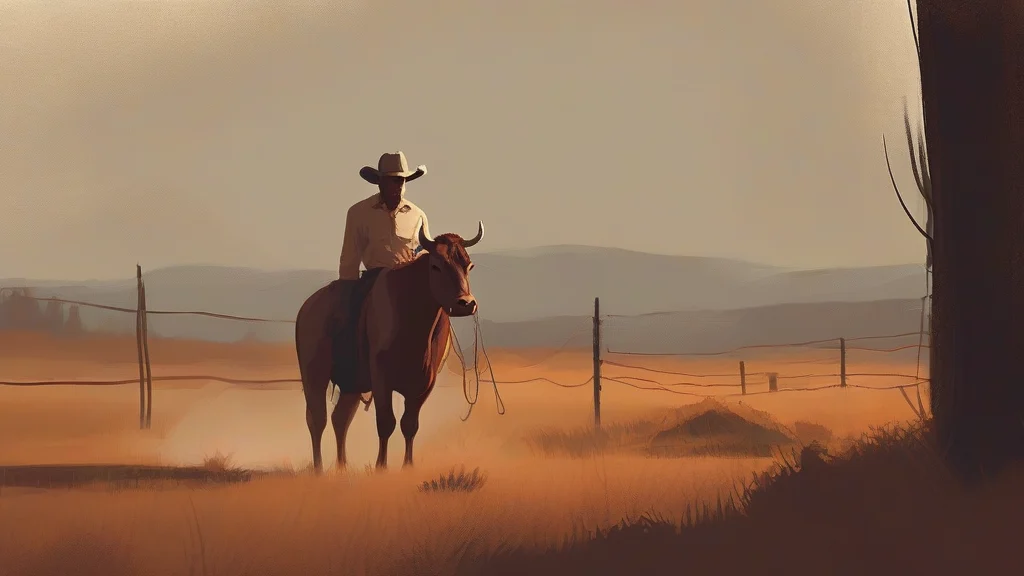
What does cowhand mean?
A cowhand is a person whose job is to tend, herd, and manage cattle, typically on a ranch — especially in the American West. The term arose from the older practice of referring to hired ranch workers simply as 'hands,' men whose labor was their stock in trade. While 'cowboy' has become the more famous and romanticized word, 'cowhand' emphasizes the working reality: long days in the saddle, driving and branding cattle, mending fences, and enduring hard weather. It is used chiefly in North America and carries a plain, unglamorous connotation compared with Hollywood versions of ranch life. Writers and speakers reach for 'cowhand' when they want authenticity over myth — for example, distinguishing the seasoned working rancher from the silver-screen gunslinger. The word remains current in ranching regions and appears frequently in Western fiction, journalism about rural life, and historical accounts of the American frontier.
nounA person employed to look after cattle, especially on a ranch in the western United States; a cowboy or cowherd.
- A person who herds and tends cattle on a ranch; a cowboy.
"The old cowhand spent forty years riding the range before settling down near Amarillo."
"Every summer she hired on as a cowhand at her uncle's ranch in Montana."
"The weathered cowhand tipped his hat and rode off toward the herd."
Standard regular plural; used when referring to multiple ranch workers.
"Half a dozen cowhands gathered around the campfire after a long day on the trail."
Long before 'cowboy' became the iconic term, ranch hands were simply called 'hands' — and 'cowhand' survives as the plain-spoken word for the people who actually did the work.
Reviewed by Deb Chak, Editor. AI-assisted content curated by RJS Tech Solutions LLP.
Etymology of cowhand
Cowhand is an American English compound formed from 'cow' + 'hand,' where 'hand' had long meant a hired worker (as in 'farmhand' and 'ranch hand'). It emerged during the great cattle-ranching era of the nineteenth-century American West, alongside terms like 'cowboy' and 'cowpuncher.' The element 'hand' traces back through Middle English to Old English 'hand,' making 'cowhand' a native Germanic formation rather than a borrowing. Its cognates are therefore other compounds built on this sense of 'hand' as a laborer.
How cowhand is actually used
The word is informal to neutral in register and carries strong associations with the American West and ranching culture. It is often preferred over 'cowboy' when emphasizing the labor of cattle work rather than romantic imagery. Though understood in British English, it is essentially an Americanism in origin and use.
Easily confused with cowhand
A coward is a person who lacks courage, while a cowhand is a worker who tends cattle on a ranch — the words sound similar but are unrelated in meaning.