What does cowry mean?
A cowry is a marine gastropod mollusc belonging to the genus Cypraea and related genera, prized for its smooth, glossy, egg-shaped shell, which is often vividly coloured or intricately patterned. The word also refers to the shell itself rather than the living animal, and it was historically significant as a form of currency across large parts of Africa, South Asia, and the Pacific, where strings of cowries functioned as money for centuries. Beyond its economic role, the cowry shell has long held symbolic value, appearing in jewellery, divination practices, and traditional dress in cultures from West Africa to China. In modern usage the word appears chiefly in natural history, anthropology, and discussions of material culture, and it remains a familiar term among shell collectors. Both 'cowry' and the variant spelling 'cowrie' are widely accepted, and the plural is normally 'cowries'.
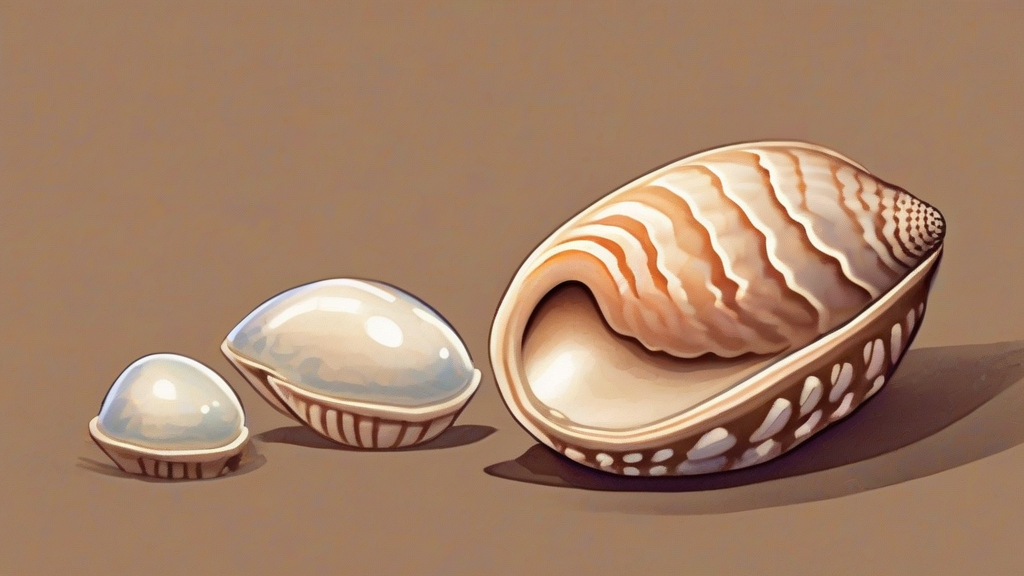
nounA cowry is a marine gastropod mollusc of the genus Cypraea (and related genera) with a glossy, brightly patterned, egg-shaped shell; the term also refers to the shell itself, especially when used as money in parts of Africa and Asia.
- The glossy, porcelain-like shell of a marine snail of the genus Cypraea or related genera, typically oval and brightly coloured.
- Such a shell, especially when used as currency or ornament in parts of Africa and Asia.
- The mollusc (sea snail) itself that produces the cowry shell.
"The trader spread out a handful of cowries on the market stall, their shells glinting in the sun."
"She wore a necklace strung with small white cowries collected on the beach."
"In parts of West Africa, cowries once served as everyday currency before colonial coinage replaced them."
The regular plural 'cowries' is standard. Occasionally, in contexts referring to shells collectively as currency, the singular form is used attributively (e.g., 'cowry money').
"Archaeologists unearthed thousands of cowries at the ancient burial site."
Reviewed by Deb Chak, Editor. AI-assisted content curated by RJS Tech Solutions LLP.
Etymology of cowry
The word 'cowry' entered English in the late seventeenth century, borrowed from Hindi and Urdu 'kaudī' (कौड़ी), which in turn derives from Sanskrit 'kaparda' meaning a cowry shell. The related spelling 'cowrie' arose as an alternative anglicisation of the same source. The term reflects the shell's long-standing importance in Indian Ocean and African trade networks, where it circulated as currency well before European contact.
How cowry is actually used
Both 'cowry' and 'cowrie' are accepted spellings, with 'cowry' more common in British English. The plural may be written as 'cowries' or, in some contexts, unchanged ('cowry'). The word carries historical connotations of trade, wealth, and ritual in African and Asian cultures.
Easily confused with cowry
Cowrie is simply an alternative spelling of the same word — both spellings refer to identical molluscs and shells, with 'cowrie' often preferred in older texts.