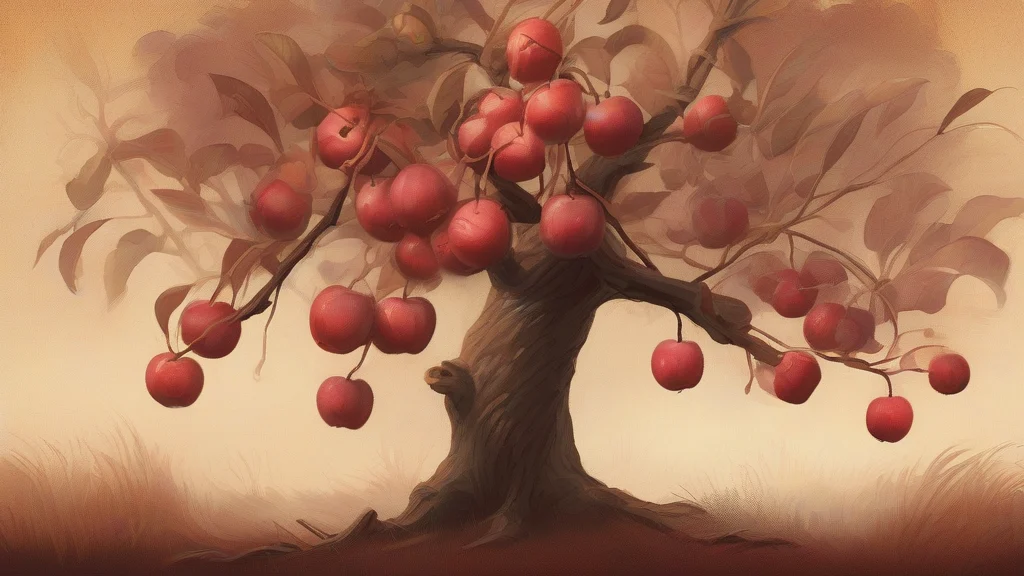
What does crabapple mean?
A crabapple is a small, sharply sour apple produced by any of several species and hybrids of the genus Malus, as well as the tree that bears it. Unlike cultivated dessert apples, crabapples are rarely eaten raw; their intense tartness instead makes them prized for jellies, sauces, ciders, and pickles, where sugar transforms their astringent juice into something bright and flavorful. The trees themselves — compact, hardy, and spectacular in bloom — are widely planted ornamentally, particularly in North American towns and suburbs, where spring brings clouds of white, pink, or crimson blossom followed by colorful persistent fruit. The word appears in both British and American English, spelled variously as 'crabapple', 'crab apple', or 'crab-apple'. Figuratively, 'crabby' associations lend the word a faintly tart connotation, but its primary use is literal: gardeners, cooks, and landscapers alike value the crabapple as a tough, beautiful, and useful member of the apple family.
nounA small, tart apple, especially one of a wild or ornamental variety; also the tree (genus Malus) that bears such fruit.
- A small, sharp-tasting apple of a wild or ornamental variety.
- The small deciduous tree (any of several species and hybrids of the genus Malus) bearing such fruit.
"The crabapple tree in the courtyard was heavy with tiny yellow-green fruit."
"She gathered a basket of crabapples to boil down into ruby-red jelly for winter."
"In spring, the flowering crabapples along the boulevard put on a spectacular show of pink blossoms."
Standard plural; also frequently written 'crab apples' depending on the spelling convention chosen elsewhere in the text.
"She harvested enough crabapples to fill four jars with jelly."
Crabapples are so sour that eating one raw can make you wince — yet simmered with sugar they make some of the finest jelly you'll ever taste.
Reviewed by Deb Chak, Editor. AI-assisted content curated by RJS Tech Solutions LLP.
Etymology of crabapple
Crabapple is an English compound formed from 'crab' — in the older sense of a wild, sour apple, a use recorded from Middle English and possibly influenced by the notion of a crab's sharp, pinching bite — plus 'apple'. The compound itself is attested by at least the early fifteenth century in forms such as 'crabbe appel'. It belongs entirely to the Germanic stock of English vocabulary, sharing roots with the common words 'apple' and 'crab' rather than deriving from Latin or Greek; related terms include the adjective 'crabbed' and the adverbial 'crabwise', both built on the same base word 'crab'.
Related word forms
How crabapple is actually used
The word is written variously as 'crabapple', 'crab apple', and 'crab-apple'; all are accepted, though modern usage increasingly favors the closed form. In North America, 'crabapple' often refers specifically to ornamental trees prized for their spring blossoms, while in Britain it more often denotes wild fruit used for cooking. The word is standard in both everyday and horticultural registers.
Easily confused with crabapple
An apple is the familiar cultivated fruit of Malus domestica, whereas a crabapple is a smaller, sourer fruit from other Malus species, usually eaten only when cooked or made into preserves.