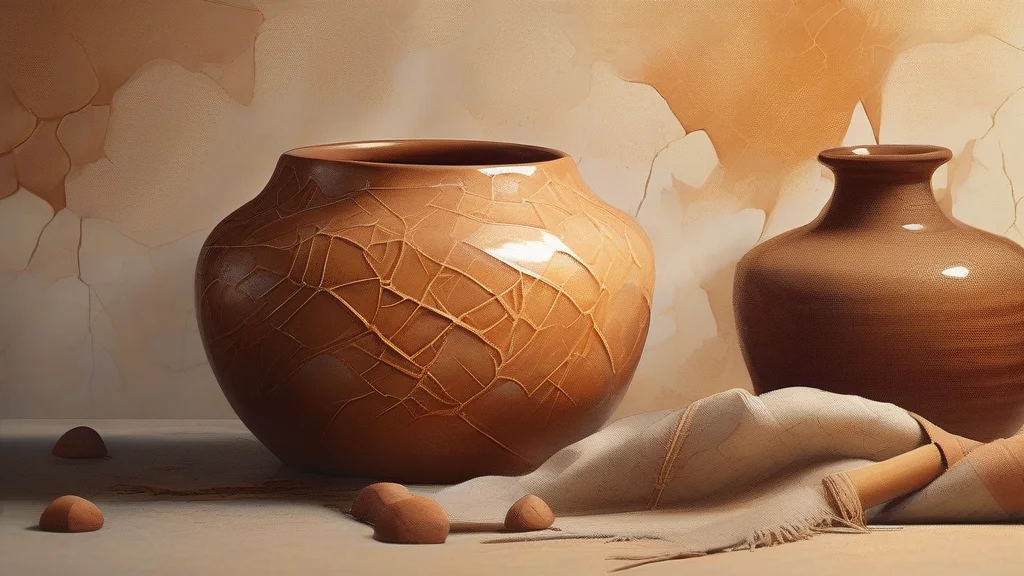
What does crackleware mean?
Crackleware is ceramic pottery whose glaze is covered with a deliberate web of fine cracks, creating a distinctive textured surface prized by collectors and potters alike. The effect arises when the glaze cools and contracts more than the clay body beneath it, causing it to fracture into a lacework of hairline lines; skilled makers control the firing and cooling process so the pattern forms evenly without weakening the piece. Crackle effects have been celebrated for centuries, notably in Chinese stoneware of the Song dynasty and later in Japanese raku tea vessels, where the veined surface was valued for its suggestion of age and natural beauty. Because the word belongs largely to the vocabulary of ceramics, antiques, and art appreciation, it rarely appears in casual conversation, but within those fields 'crackleware' precisely distinguishes intentional crackled glazes from accidental crazing, which is regarded as a flaw rather than a decorative feature.
nounPottery or ceramic ware whose glaze is deliberately decorated with a fine network of cracks, produced by cooling the glaze and body at different rates.
- Ceramic ware with a decorative network of fine cracks in its glaze.
"The collector displayed her Japanese crackleware on a shelf above the fireplace."
"The museum's Song dynasty crackleware was displayed under soft lighting to show off its intricate glaze patterns."
"She chose rustic crackleware bowls for the table, their aged surfaces lending the setting a quiet elegance."
Rarely pluralized; the noun usually functions as a mass noun, though 'cracklewares' occasionally appears when distinguishing different traditions or types of crackled ceramics.
"Her catalogue compared Chinese and Persian cracklewares side by side."
Those delicate spiderweb lines on antique Chinese vases aren't damage — potters spent centuries perfecting the art of making clay crack on purpose.
Reviewed by Deb Chak, Editor. AI-assisted content curated by RJS Tech Solutions LLP.
Etymology of crackleware
Crackleware is formed from two transparent English elements: 'crack', a Middle English verb of Germanic origin meaning to break with a sharp sound, and the suffix '-ware', from Old English 'waru', denoting manufactured goods. As a compound it arose in English usage describing glazed ceramics, gaining currency as interest in East Asian pottery spread among European collectors and connoisseurs. It shares the '-ware' element with many other terms for classes of goods, such as earthenware, stoneware, and tableware.
How crackleware is actually used
A specialist term used mainly in ceramics, antiques, and art contexts; in everyday speech people are more likely to describe the finish as a 'crackle glaze'. The cracking is intentional and prized, not a defect.
Easily confused with crackleware
Crazing refers to the network of fine cracks itself (often an unintended flaw), while crackleware is pottery on which such cracking is intentionally created as decoration.