What does crake mean?
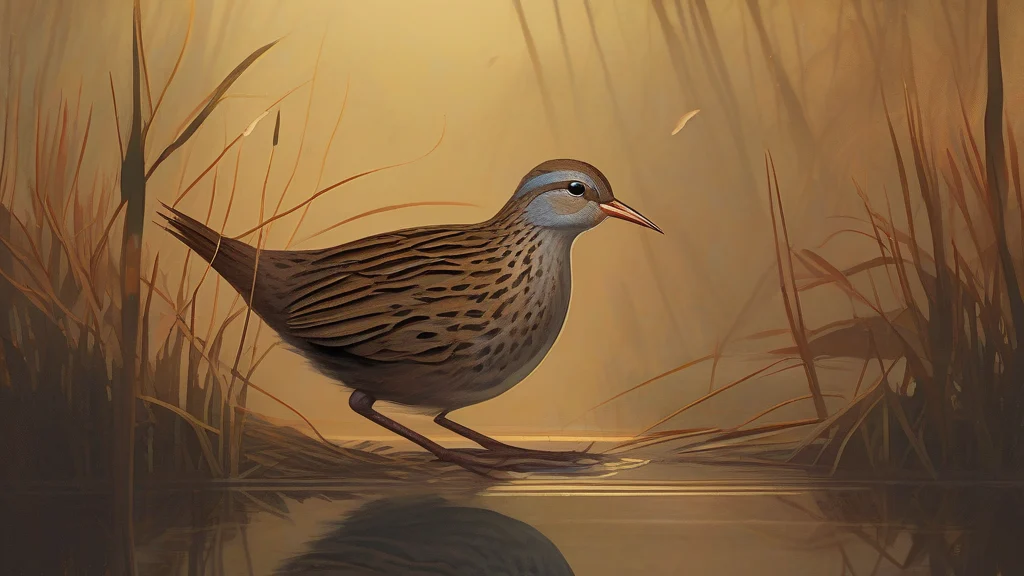
A crake is a small to medium-sized bird belonging to the rail family, Rallidae, characterised by a relatively short bill, laterally compressed body suited to moving through dense vegetation, and a marked preference for staying hidden. Crakes inhabit marshes, wet grasslands, and meadows across much of the world, and they are notoriously difficult to observe, being far more often heard than seen. The best-known species include the corncrake (Crex crex), whose loud, rasping nocturnal call was once a familiar sound of European hayfields, and various spotted and Baillon's crakes found in reedbeds. Because these birds skulk in cover, the word has little figurative use and appears chiefly in ornithology, birdwatching literature, and conservation writing. Several crake species are of conservation concern, as changes in mowing regimes and wetland drainage have sharply reduced their breeding habitat in recent decades.
nounA crake is a short-billed bird of the rail family (Rallidae), especially the corncrake, known for its harsh, grating call and secretive behaviour in dense vegetation.
- A short-billed bird of the rail family (Rallidae), typically secretive and found in marshes or grassland, such as the corncrake or spotted crake.
"The corncrake's rasping call echoed across the hay meadow long after dark."
"Birders waited for hours in the reeds hoping to glimpse the elusive spotted crake."
"The corncrake, once widespread across rural Ireland, now survives mainly in a few western strongholds."
Regular plural; used when referring to multiple individuals or multiple species collectively.
"Several crakes were recorded at the reserve during the autumn migration count."
The corncrake — a kind of crake — was once so common in British meadows that its rasping 'crex crex' was a soundtrack of summer; modern mowing has made it one of Britain's most endangered breeding birds.
Reviewed by Deb Chak, Editor. AI-assisted content curated by RJS Tech Solutions LLP.
Etymology of crake
The word 'crake' is of imitative (onomatopoeic) origin, echoing the harsh, creaking call of the bird it names. It arose in Middle English, likely reinforced by Old Norse, and belongs to a wider Germanic family of sound-symbolic words including 'crack' and 'crackle'. The name was first applied broadly to calling birds before becoming fixed in ornithological usage for members of the rail family.
How crake is actually used
Most often encountered in ornithological or nature-writing contexts rather than everyday speech; 'crake' alone frequently refers generically to rails of the genera Crex, Porzana, and allies.
Easily confused with crake
A crank is an eccentric person or a device for converting rotary motion, whereas a crake is a secretive marsh bird of the rail family.