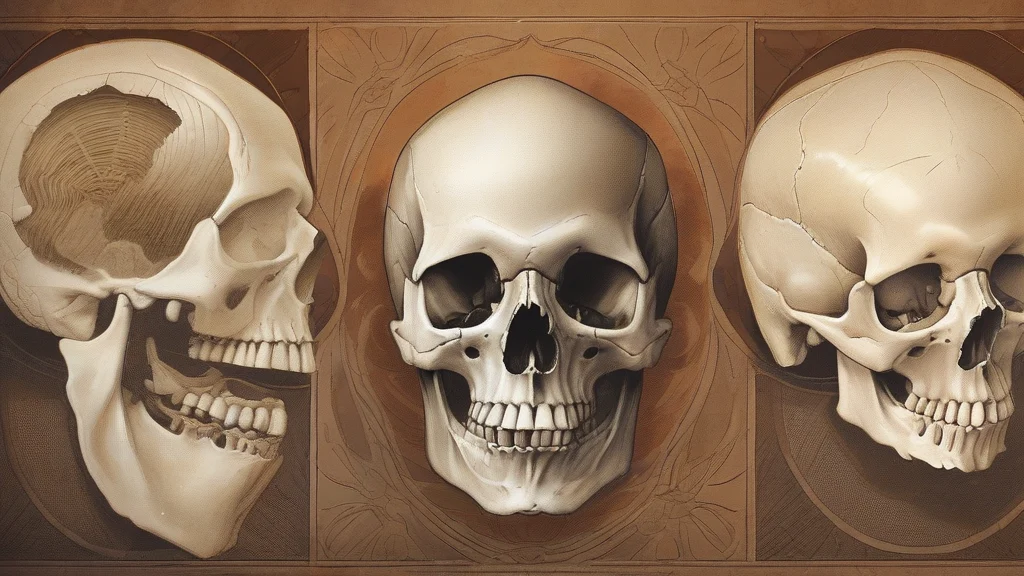
What does craniological mean?
"Craniological" is an adjective meaning relating to the study of the skull — its size, shape, proportions, and structural features. It derives from "craniology," a branch of physical anthropology and anatomy in which researchers measure and compare crania to draw conclusions about human variation, ancestry, development, and health. In practice, craniological evidence might include measurements taken with calipers on excavated remains, statistical comparisons across populations, or assessments of trauma and pathology preserved in bone. The word is strictly technical: it belongs to peer-reviewed papers, museum catalogues, and graduate seminars rather than everyday conversation. Historically it carries some weight, since nineteenth-century craniology was misused to prop up racist classification systems; contemporary scholars apply far more rigorous quantitative methods. Related terms include "craniometry" (the measurement of the skull) and "cranial" (simply relating to the cranium), but only "craniological" signals the broader scientific study of skulls as a discipline. Its adverbial derivative, "craniologically," sees occasional use.
adjectiveRelating to the scientific study of the shape, size, and structure of the skull (craniometry/craniology).
- Of or relating to craniology — the branch of anthropology concerned with the scientific study of the skull's form and structure.
"The museum's craniological collection helped researchers trace migration patterns across ancient Europe."
"Her doctoral thesis drew on craniological measurements of Bronze Age burials to argue for two distinct population groups in the region."
"Nineteenth-century craniological collections, once used to support now-rejected racial hierarchies, are today studied with far more rigorous methods."
Before DNA testing, scientists could tell where ancient people came from just by measuring their skulls — that's craniology in action.
Reviewed by Deb Chak, Editor. AI-assisted content curated by RJS Tech Solutions LLP.
Etymology of craniological
The word combines "cranium" — the Latin term for the skull, itself borrowed from the Greek "kranion" (κρανίον), meaning the upper part of the head — with the combining form "-logical," from Greek "logia" (study or discourse). Craniology emerged as a named field during the late eighteenth and early nineteenth centuries, when European anatomists began systematically collecting and measuring skulls. Cognate formations include "craniometry," "craniologist," and the adjective "cranial."
Related word forms
How craniological is actually used
A technical term confined to academic writing in physical anthropology, archaeology, and anatomy. Because early craniology was entangled with discredited racial typology, the word can carry historical baggage; modern usage typically appears alongside careful methodological framing. Not used in everyday speech.
Easily confused with craniological
'Craniological' refers to the objective measurement and study of skull structure, whereas 'phrenological' relates to the discredited 19th-century pseudoscience of reading personality from skull bumps.
'Cranial' simply means relating to the skull itself, while 'craniological' specifically concerns the study or science of skulls.