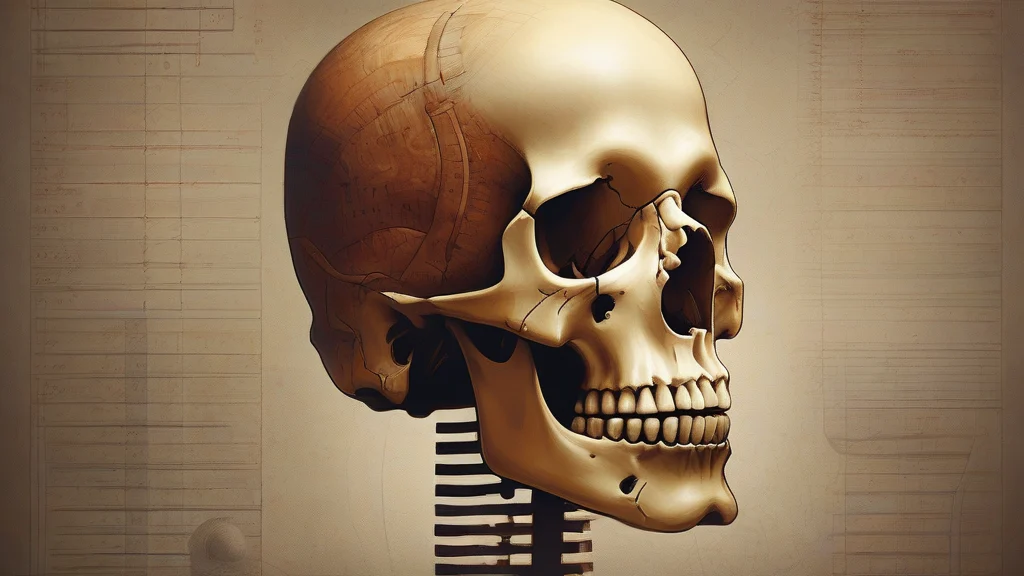
What does craniometry mean?
Craniometry is the scientific practice of measuring the skull — its overall capacity, length, breadth, height, and various proportions expressed as indices. Emerging as a formal discipline in the late eighteenth and nineteenth centuries, it was embraced by physical anthropologists who believed that skull dimensions could be correlated with intelligence, temperament, and racial type. That premise has been thoroughly rejected: modern genetics and neuroscience show no meaningful link between crude cranial measurements and cognitive ability. Nevertheless, craniometric methods retain legitimate applications in forensic science, where measurements of skeletal remains help estimate sex, age, and ancestral background, and in palaeoanthropology, where they assist in classifying fossil hominins. The word is technical and formal, appearing mainly in academic writing about the history of anthropology, forensic identification, or human evolution. It is closely associated with — but distinct from — phrenology, which made even bolder claims about reading character from the skull.
nounThe scientific measurement of the skull, especially of its size, capacity, and proportions, historically used in attempts to correlate cranial features with intelligence or race.
- The branch of anthropology concerned with taking precise measurements of the human skull (capacity, length, breadth, indices), formerly used in racial classification and studies of intelligence.
"Nineteenth-century craniometry claimed to rank human races by skull capacity, a practice now thoroughly discredited."
"Morton's craniometry of the 1830s measured hundreds of skulls in an attempt to establish racial hierarchies of brain size."
"In forensic labs today, craniometric techniques help estimate ancestry and sex from skeletal remains."
Rarely pluralised; when used in the plural it typically refers to different systems or traditions of skull measurement rather than multiple individual measurements, for which 'craniometric data' or 'measurements' is preferred.
"Comparative studies have examined the competing craniometries developed by Morton and Broca."
Victorian scientists filled museums with thousands of skulls to prove their own race was smartest by measurement — and got it wrong every time.
Reviewed by Deb Chak, Editor. AI-assisted content curated by RJS Tech Solutions LLP.
Etymology of craniometry
Craniometry derives from Greek 'kranion', meaning skull, combined with '-metry', from the Greek 'metron' meaning measure. The compound entered English usage in the mid-nineteenth century, when physical anthropology was formalising its measurement techniques. It shares this root with related terms such as craniology, cranium, and cranial, all built on the same Greek word for the upper part of the skull.
Related word forms
How craniometry is actually used
Formal, technical register, found in anthropological, historical, and forensic literature. Because of its association with discredited nineteenth-century racial science, the word often carries an implicitly critical or cautionary connotation when invoked in modern scholarly discussion.
Easily confused with craniometry
Phrenology claims that the shape of the skull reveals mental faculties and character, whereas craniometry is simply the measurement of skull dimensions — though both were discredited racial-science tools.
Cephalometry measures the whole head (especially in orthodontics and radiography), while craniometry is confined to measuring the skull itself.