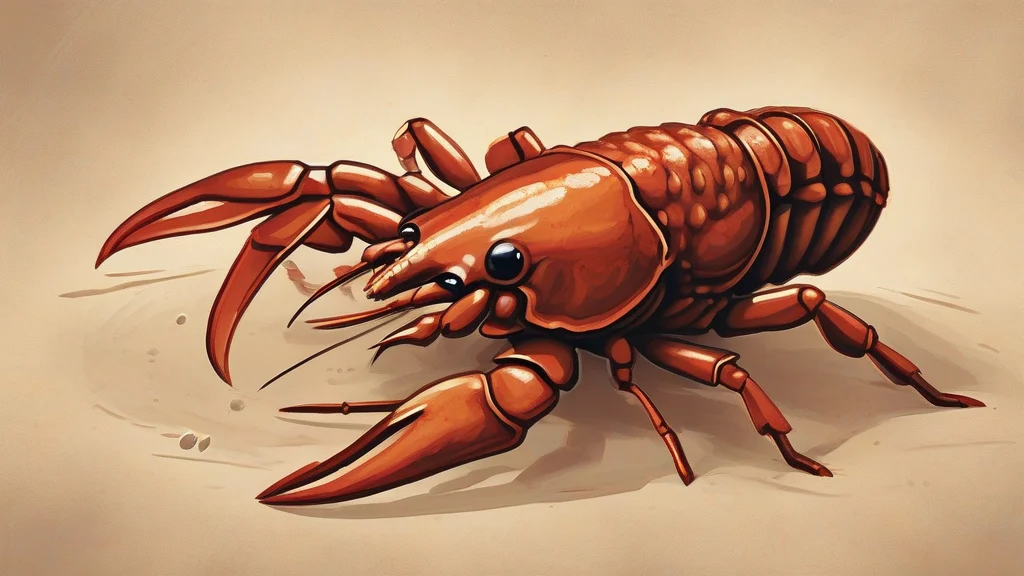
What does crayfish mean?
A crayfish is a small freshwater crustacean that closely resembles a miniature lobster, with a jointed armored shell, ten legs including two prominent pincers, and a muscular tail it flicks to swim backward when startled. Found in streams, lakes, and rivers on every continent except Africa's polar regions, crayfish are largely nocturnal scavengers and predators that hide among rocks and vegetation. The word is standard in British English, while Americans often say crawfish or crawdad for the same creature. Crayfish are economically and culturally significant: they are trapped commercially, feature prominently in Louisiana Creole cuisine and Scandinavian crayfish parties, and serve as important indicators of water quality in ecological studies. Some introduced species, such as the signal crayfish in Britain, have become invasive and threaten native populations.
nounA freshwater crustacean resembling a small lobster, with a segmented body, a pair of large pincer-like claws, and a long tail; also called a crawfish or crawdad in North America.
- A freshwater crustacean of the families Astacidae, Cambaridae, or Parastacidae, resembling a small lobster.
- (As food) The edible flesh of this crustacean, eaten in cuisines worldwide.
"The children spent the afternoon turning over stones in the creek, hoping to catch a crayfish."
"Fishermen baited their traps and left them overnight in the lake to catch crayfish."
"The Cajun restaurant served pounds of boiled crayfish seasoned with cayenne and garlic."
Usually uncountable-style plural like 'fish'; 'crayfishes' appears mainly in scientific writing referring to multiple species.
"The biologist counted hundreds of crayfish beneath the overturned stones."
The word 'crayfish' doesn't come from any fish at all — it's a mangled borrowing of a French word for 'crevice', because these creatures hide in rock cracks.
Reviewed by Deb Chak, Editor. AI-assisted content curated by RJS Tech Solutions LLP.
Etymology of crayfish
The word 'crayfish' entered Middle English in the Middle Ages as a folk-etymological alteration of Old French 'crevice', which itself derives from a Germanic root meaning 'crevice', a reference to the animal's habit of sheltering in rock fissures. The second syllable was reshaped by association with 'fish', although crayfish are crustaceans, not fish. American variants 'crawfish' and 'crawdad' arose later through similar reshaping and dialectal blending.
How crayfish is actually used
'Crayfish' is the standard British term; in much of the United States 'crawfish' (especially in the South) or 'crawdad' (informal, western) are more common for the same animals. The plural is usually 'crayfish', though 'crayfishes' is occasionally used when referring to multiple species.
Easily confused with crayfish
Crawfish is simply the American variant of the same word rather than a different animal, while 'crayfish' is the standard form in British English.
Lobsters are large saltwater crustaceans, whereas crayfish are their much smaller freshwater counterparts.