What does creamware mean?
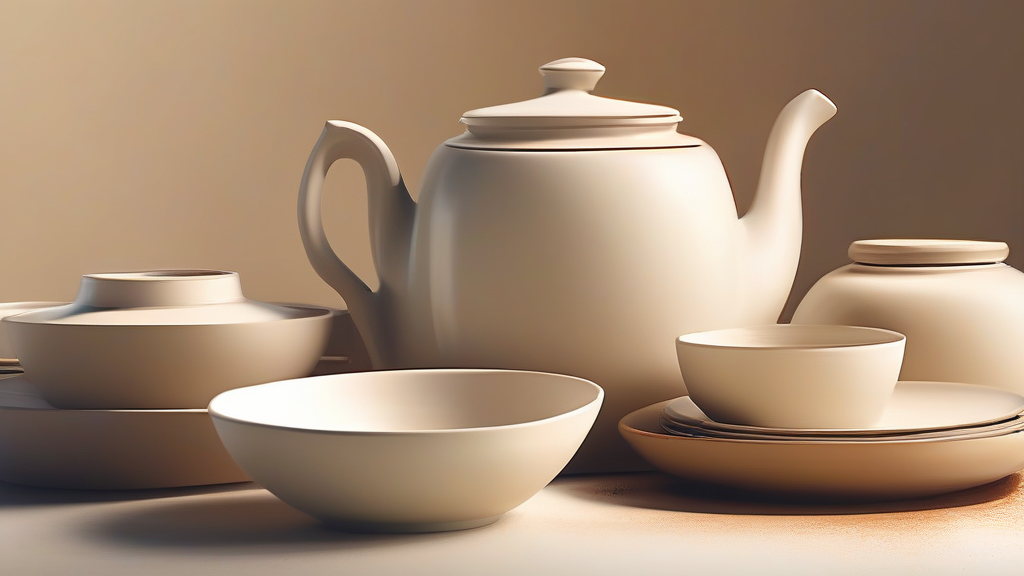
Creamware is a type of fine, cream-coloured earthenware pottery developed in England during the mid-18th century. Made by combining white clay with ground flint and finished with a clear lead glaze, it offered potters a lighter, more affordable alternative to porcelain while retaining an attractive pale surface suitable for decoration. The Staffordshire potter Josiah Wedgwood perfected and popularised the ware; his celebrated variant, renamed 'Queen's Ware' after Queen Charlotte ordered a set in 1765, helped establish British ceramics as a major export industry. Other centres, notably Leeds, produced distinctive creamware of their own. Today the word appears chiefly in the contexts of antiques collecting, museum catalogues, and ceramic history, where it denotes both the material itself and individual vessels made from it. Collectors prize 18th-century examples for their moulded forms, enamelled ornament, and historical significance.
nounCreamware is a refined, cream-coloured earthenware pottery made from white clay and flint, first perfected in the mid-18th century. It is especially associated with the English potter Josiah Wedgwood, who developed a celebrated version known as Queen's Ware.
- A type of cream-coloured lead-glazed earthenware developed in England in the mid-18th century, made from white clay mixed with flint.
"The auction featured an extensive collection of 18th-century creamware, including several Wedgwood plates with delicate transfer-printed decoration."
"The museum's collection of Leeds creamware includes finely moulded dishes and pitchers from the 1780s."
"She displayed her grandmother's antique creamware tureen on the sideboard as the centrepiece of the dining room."
The plural form 'creamwares' is occasionally used by collectors and curators to refer to multiple distinct pieces or varieties of creamware, though 'creamware' as a mass noun is far more common.
"The exhibition brought together creamwares from Staffordshire, Leeds, and Liverpool."
When Queen Charlotte ordered a set of this creamy new pottery in 1765, she was so delighted she gave it her own name — 'Queen's Ware' — turning an English potter's experiment into royal fashion.
Reviewed by Deb Chak, Editor. AI-assisted content curated by RJS Tech Solutions LLP.
Etymology of creamware
The word creamware is a straightforward compound of 'cream', referring to the ware's characteristic pale yellowish-ivory colour, and 'ware', meaning manufactured goods or pottery — a term of Old English origin (waru). The compound arose in 18th-century England alongside the pottery it describes, as makers sought a name for the new light-bodied earthenware. Related descriptive compounds such as pearlware and Queensware followed the same pattern.
How creamware is actually used
Creamware is primarily used in discussions of ceramics, antiques, and decorative arts, so it carries a somewhat specialist or collector's register. The term is uncountable when referring to the material generally but can be treated as countable ('a piece of creamware', 'creams wares' is not standard — pieces are described as 'pieces of creamware'). Capitalisation is generally lowercase except for named varieties such as Queen's Ware.
Easily confused with creamware
Pearlware is a later (c. 1779) refinement of creamware with added cobalt that gives the glaze a bluish-white tint, whereas creamware has a distinctly warm, creamy colour.
Stoneware is fired at a higher temperature to produce a dense, non-porous body, while creamware is a softer earthenware that remains slightly porous beneath its glaze.