What does crepuscle mean?
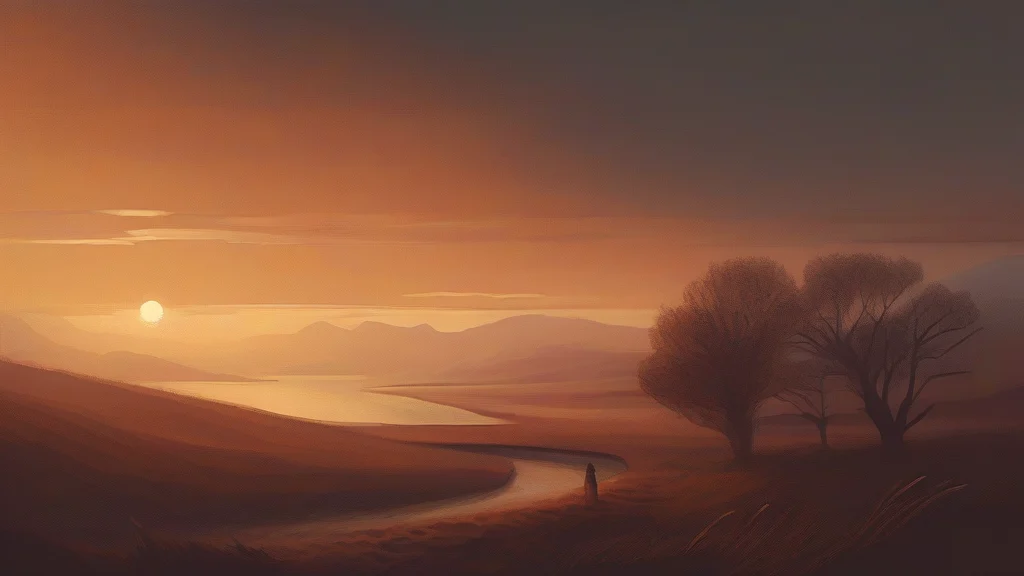
Crepuscle is a rare English noun denoting twilight — the soft, dim light that lingers just after sunset or just before sunrise. It is a variant of the older borrowing 'crepuscule', both deriving from the Latin crepusculum, meaning dusk or twilight. The related adjective 'crepuscular' is far better known, especially in biology, where it describes animals active during those low-light hours. As a standalone noun, crepuscle survives mainly in literary and poetic writing, where it lends an archaic, atmospheric elegance to descriptions of evening or dawn scenes. A writer might describe a landscape dissolving into crepuscle rather than plain twilight, trading clarity for mood. Because the word is uncommon, readers may find it unfamiliar or even obscure, so it suits contexts where a heightened, lyrical register is welcome. For everyday purposes 'twilight' remains the standard choice, while crepuscle offers a distinctive flourish for those who want one.
nounA rare, chiefly literary word for twilight — the dim light of dusk or dawn. It is a variant of 'crepuscule' and carries the same poetic, evocative force.
- The period of fading light at dusk or dawn; twilight.
"The garden fell silent in the soft grey crepuscle after sunset."
"They lingered on the terrace until the last crepuscle dissolved into full dark."
"Birdsong filled the crepuscle of early morning before the sun cleared the hills."
The plural is rare, as the word typically refers to a general state of half-light rather than countable instances.
"Autumn's long crepuscles lent the valley an air of quiet melancholy."
Before 'twilight' took over, English speakers had this lovely Latin-born word for the hour when day fades into night.
Reviewed by Deb Chak, Editor. AI-assisted content curated by RJS Tech Solutions LLP.
Etymology of crepuscle
Crepuscle comes from the Latin crepusculum, meaning twilight or dusk, a derivative of crepusculum's root associated with the dim, uncertain light of morning and evening. English adopted the word via French crépuscule, with 'crepuscule' appearing from around the sixteenth century and 'crepuscle' arising as a shortened variant. Its closest relative in modern English is the adjective 'crepuscular', which remains in active use, particularly in zoology to describe creatures such as bats and deer that are active at twilight.
Related word forms
How crepuscle is actually used
Crepuscle is a rare, literary word, used almost exclusively for deliberate stylistic or poetic effect. Most readers will know its close relative 'crepuscule', which appears more often in print. Neither is common in everyday speech, where 'twilight' or 'dusk' would normally be used.
Easily confused with crepuscle
'Crepuscule' is the more established spelling of essentially the same word; 'crepuscle' is a rarer variant form, and the two mean exactly the same thing.