What does crinoid mean?
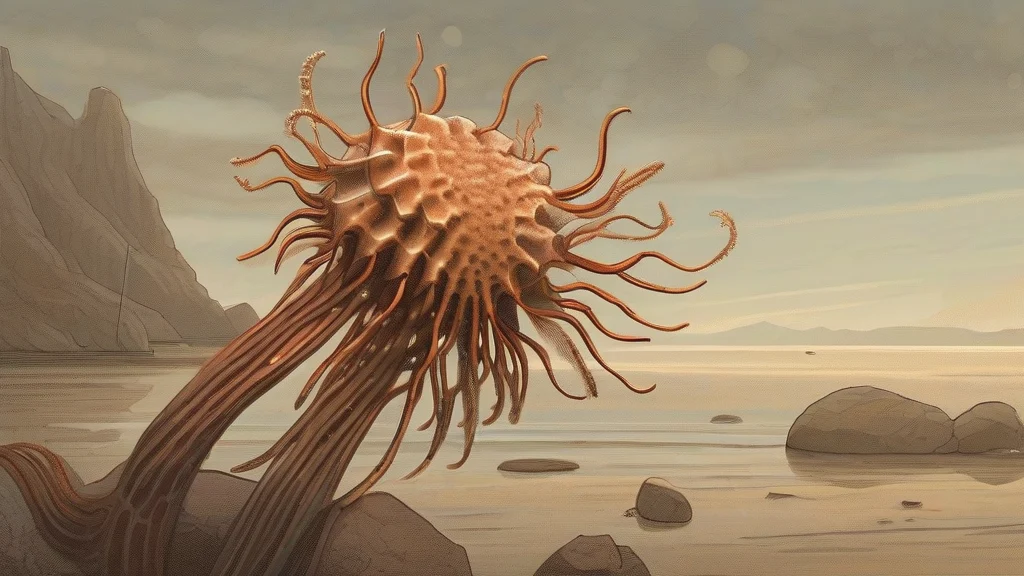
A crinoid is a marine animal belonging to the class Crinoidea, a group of echinoderms that includes starfish, sea urchins, and sea cucumbers. Most people know crinoids by their common names: stalked species anchored to the seafloor are called sea lilies because their cupped bodies and feathery, flower-like arms resemble plants, while unstalked species that can move about are known as feather stars. Despite their floral appearance, crinoids are animals that feed by extending their arms into the current to capture drifting plankton and organic particles. They first appeared roughly 480 million years ago, reached extraordinary abundance in the Paleozoic era, and survive today in oceans worldwide, mostly at depth or in tropical waters. Crinoid skeletons, made of countless small calcified plates, are extremely durable: vast accumulations of broken stems and plates form whole beds of limestone, making crinoids among the most familiar fossils. The word carries a technical, natural-history flavor and appears mainly in scientific writing, museum contexts, and discussions of fossils and marine life.
nounA marine invertebrate animal of the class Crinoidea, related to starfish and sea urchins, with a body (calyx) mounted on a stalk of calcified plates and arms used for filter-feeding; also called a sea lily. The word is also applied adjectivally to things relating to crinoids.
- A marine echinoderm of the class Crinoidea, typically having a cup-shaped body borne on a jointed stalk, with feathery arms for filter-feeding; commonly called a sea lily or feather star.
- (Attributive use) Relating to or characteristic of crinoids, as in 'crinoid limestone' or 'crinoid stem'.
"The limestone cliffs were packed with fossilized crinoid stems, fragments of sea lilies that flourished hundreds of millions of years ago."
"Divers spotted delicate feather stars — unstalked crinoids — curling their arms through the current to trap drifting plankton."
"Much of the Mississippian limestone in the American Midwest is so dense with crinoid fragments that it is informally called crinoidal marble."
Regular plural. When referring collectively to the group as a biological class, the singular mass noun 'the Crinoidea' may be used instead.
"Crinoids thrived in the shallow seas of the Paleozoic, leaving behind immense beds of skeletal debris."
Crinoids look like flowers swaying on the seabed, but they're animals — cousins of starfish that have been filtering ocean water for roughly 480 million years.
Reviewed by Deb Chak, Editor. AI-assisted content curated by RJS Tech Solutions LLP.
Etymology of crinoid
The word crinoid derives from modern Latin Crinoidea, the class name coined in the early 19th century from Greek krinon, meaning 'lily', combined with the suffix -oid, meaning 'having the form of' — literally 'lily-like', a reference to the animals' flower-like appearance. The Greek root krinon is shared with other English words such as crinoline, originally the stiff horsehair-and-linen fabric whose name likewise invokes a lily-like shape, and crinum, the genus name of certain lilies. The term entered English scientific usage as paleontologists recognized how abundant these organisms were in the fossil record.
Related word forms
How crinoid is actually used
The term is chiefly scientific or paleontological in register. Stalked forms are popularly called 'sea lilies' and unstalked, free-swimming forms 'feather stars'; both are crinoids. In casual speech, 'sea lily' and 'feather star' are far more common than the technical term itself.
Easily confused with crinoid
A carcinoid is a type of slow-growing neuroendocrine tumor, whereas a crinoid is a marine echinoderm; the two words merely sound similar.