What does crinoline mean?
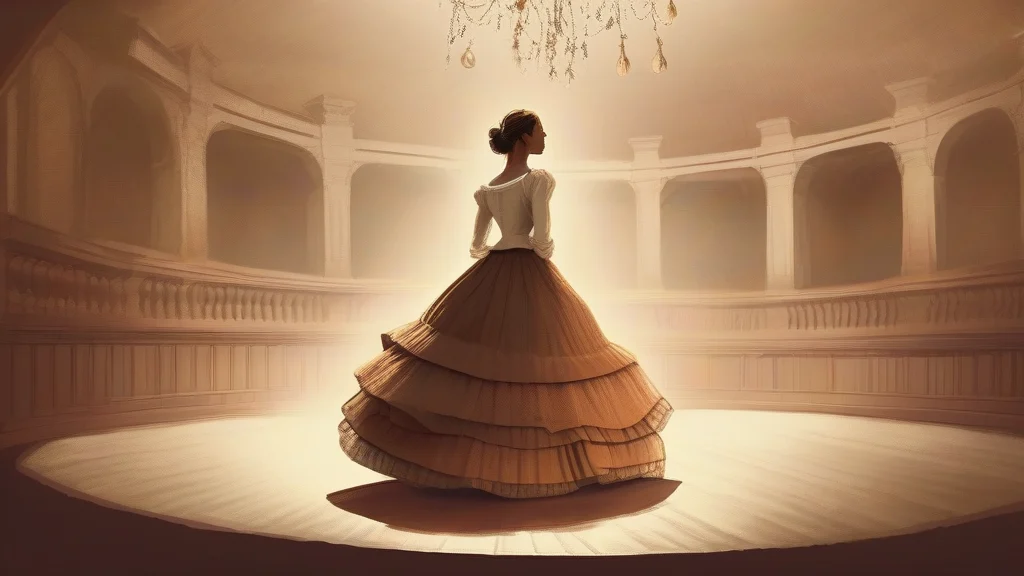
A crinoline is a structured underskirt, stiffened either by a woven fabric of horsehair and linen or by graduated steel hoops, worn to hold a woman's skirt out into a full, bell-like shape. The word names both the garment and, originally, the coarse stiffening material itself. Crinolines reached their greatest size and popularity in Europe and America during the mid-nineteenth century, when they replaced layers of heavy petticoats and created the era's iconic wide-skirted silhouette. The term derives from French, combining crin (horsehair) with lin (linen), reflecting its material origins. Today the crinoline survives mainly in historical costume, bridal wear, and theatrical dress, and the word carries strong connotations of Victorian formality and elaborate feminine fashion. It is closely studied by historians of dress, both for its aesthetic impact and for the practical hazards its enormous dimensions once posed.
nounA stiffened or hooped petticoat worn to hold out a woman's skirt, especially the large bell-shaped support garment fashionable in the mid-19th century; also the coarse fabric of horsehair and linen thread originally used to make such petticoats.
- A hooped or stiffened underskirt worn to extend and shape a woman's skirt, especially the voluminous bell-shaped garment of the mid-1800s.
- The stiff fabric of horsehair and linen thread from which early crinolines were made.
"The bride's vast crinoline swept across the ballroom, brushing candles aside as she turned."
"Her crinoline filled the entire doorway as she entered the drawing room."
"Dressmakers of the 1850s stitched stiff crinoline into layers beneath skirts to achieve the fashionable dome silhouette."
Regular plural; commonly used when discussing collections of garments or multiple examples in historical contexts.
"The costume archive houses dozens of antique crinolines from the Victorian era."
At its peak, the Victorian crinoline was so wide that wearers regularly caught fire from fireplaces — it remains one of fashion's most dangerous inventions.
Reviewed by Deb Chak, Editor. AI-assisted content curated by RJS Tech Solutions LLP.
Etymology of crinoline
The word 'crinoline' comes from French, coined in the early nineteenth century from crin, meaning horsehair (ultimately from Latin crinis, 'hair'), joined with lin, referring to linen (from Latin linum). It thus literally describes the horsehair-and-linen fabric first used to make stiffened petticoats. As steel-hooped versions superseded the fabric kind, the word transferred naturally to the hooped garment itself, and it spread into English alongside the fashion it named.
How crinoline is actually used
Used almost exclusively in historical, costume, or fashion contexts today; 'crinoline' can refer both to the garment itself and to the horsehair-based stiffening material, so context usually clarifies which sense is meant.
Easily confused with crinoline
A farthingale was an earlier (16th–17th century) hooped undergarment using rigid hoops of whalebone or wicker, whereas the crinoline is chiefly a mid-19th-century structure, at first of horsehair-and-linen fabric and later of steel hoops.