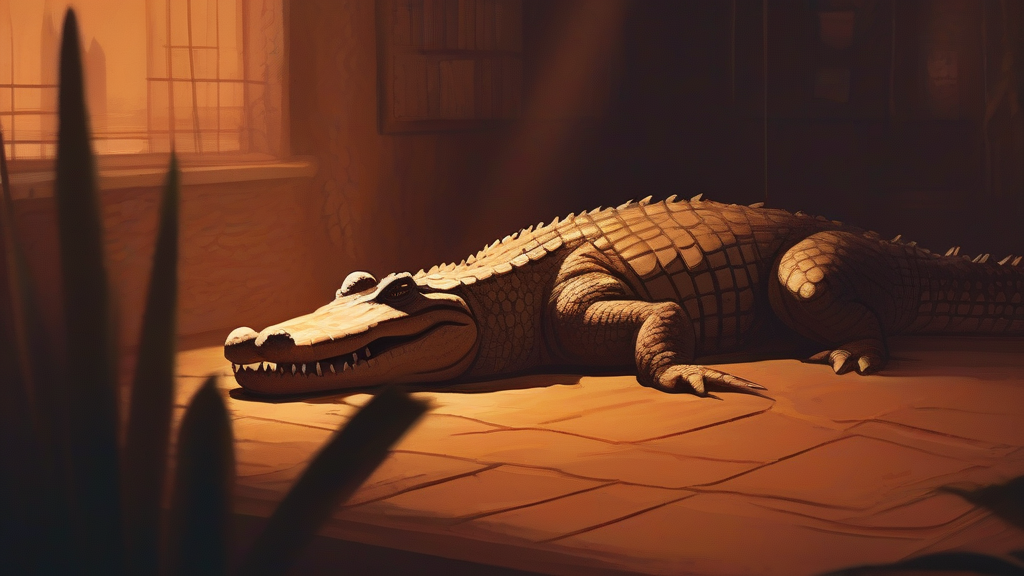
What does crocodile mean?
A crocodile is a large, powerful semiaquatic reptile belonging to the family Crocodylidae, found throughout tropical Africa, Asia, the Americas, and Australia. It is distinguished by a long, V-shaped snout, a thick armor of scaly skin, webbed hind feet, and jaws capable of exerting enormous force. Crocodiles are ambush predators, spending much of their time drifting at the water's surface before lunging at prey ranging from fish to mammals. In everyday usage the word is often extended informally to related reptiles such as alligators and caimans, although strictly speaking those belong to different families. Beyond its zoological sense, 'crocodile' has a chiefly British figurative meaning: a procession of people, typically schoolchildren, walking in pairs. The animal carries strong cultural connotations of stealth, patience, and danger, reflected in expressions such as 'crocodile tears,' meaning insincere grief. Familiarity with the word matters both for describing one of nature's most formidable survivors and for understanding these idiomatic uses.
A large, predatory semiaquatic reptile of the family Crocodylidae, characterized by a long tapered snout, thick scaly hide, and powerful jaws; informally, any similar large crocodilian.
"An estuarine crocodile can grow to more than six meters in length."
Zoologically restricted to Crocodylidae, but commonly used loosely for alligators and caimans.
(Chiefly British) A line of people, especially schoolchildren, walking two abreast.
"The pupils crossed the road in a crocodile under the supervision of two teachers."
The regular English plural applies to individual animals. When referring collectively to the group as a category, writers may prefer 'the crocodile' in a generic singular construction.
"Crocodiles bask along the riverbank during the dry season."
The word 'crocodile' comes from ancient Greek krokodilos, meaning literally 'pebble worm' — a name inspired by the reptile's habit of basking on gravelly riverbanks.
Reviewed by Deb Chak, Editor. AI-assisted content curated by RJS Tech Solutions LLP.
Etymology of crocodile
The word 'crocodile' entered English in the early modern period via Latin crocodilus and Old French cocodrille, ultimately deriving from the ancient Greek krokodeilos. The Greek compound is traditionally explained as combining krokē ('pebble') and drilos ('worm'), an allusion to the animal's habit of basking on stony riverbanks. Early English texts also used the now-obsolete variant 'corcodile.' The adjective 'crocodilian,' coined later from the same Latin stem, serves as the formal scientific term for the wider order that includes crocodiles, alligators, and gharials.
Related word forms
How crocodile is actually used
In everyday speech, 'crocodile' is often applied loosely to alligators and other crocodilians, though zoologically it refers specifically to members of the family Crocodylidae. The British sense denoting a file of walking children is well established in school contexts but unfamiliar to many American speakers. The plural 'crocodiles' is standard; as a collective term, 'crocodile' itself can be used attributively, as in 'crocodile habitat.'
Easily confused with crocodile
Alligators have broader, U-shaped snouts and live mainly in freshwater in China and the southeastern United States, whereas crocodiles have narrower, V-shaped snouts and are found across tropical Africa, Asia, the Americas, and Australia.