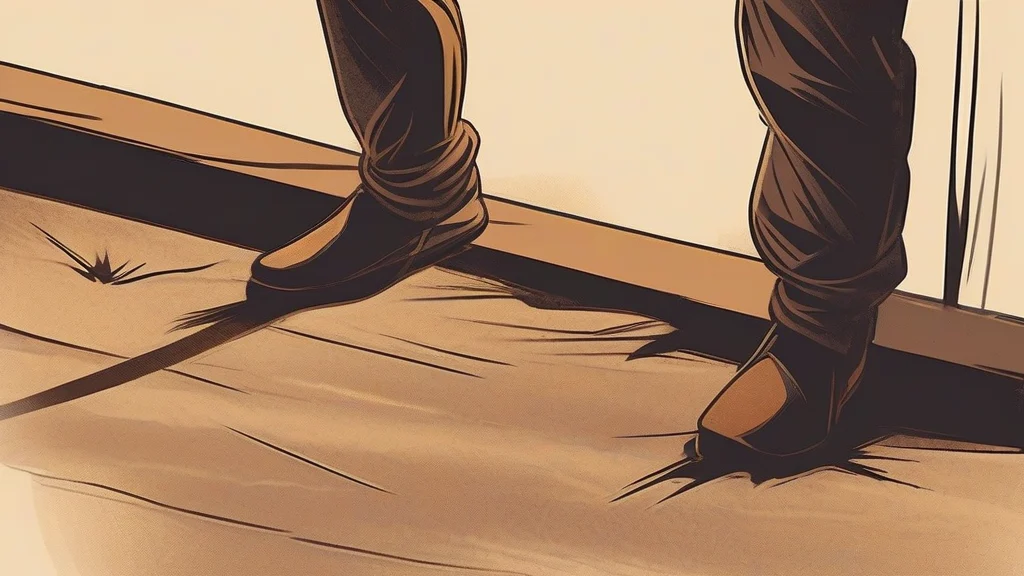
What does crouching mean?
"Crouching" refers to the act of bending the body forward and downward with the knees drawn up so that one hovers close to the ground. It is most commonly used as the present participle of the verb "crouch" — describing someone in the process of lowering themselves — but also works as a descriptive modifier, as in "a crouching figure" or "a crouching start." The posture suggests several things at once: concealment, caution, readiness to move, or deference, which gives the word a quietly dramatic quality. Athletes adopt a crouching position before a sprint; animals are seen crouching before they pounce; characters in stories crouch to hide or eavesdrop. Derived from the same Germanic root that gave us "crook" and "hook," the word evokes the body curling inward like a bent implement. Its vividness makes it a staple of both everyday description and literary prose.
Bending low with the knees drawn up and the body close to the ground.
"He was crouching behind the wall, listening for footsteps."
Most common in the progressive tense ("is crouching") or as a descriptive participle modifying a noun.
Describing something held in or characterized by a crouched posture.
"A crouching lion guarded the entrance to the building."
Common in fixed expressions like "crouching start" and "crouching figure."
The word "crouch" shares an ancestor with "crochet" — both trace back to a Germanic root meaning "hook," which is why crouching literally curls your body into a hook shape.
Reviewed by Deb Chak, Editor. AI-assisted content curated by RJS Tech Solutions LLP.
Etymology of crouching
The verb "crouch" entered Middle English from Old French "crouchier" or "crochier" ("to bend"), itself derived from "croche" or "croque" meaning hook, which traces back through Frankish to the Proto-Germanic root *krūk-, meaning "hook" or "something bent." This same root produced English words such as "crook," "encroach," "crutch," and "crochet." The word has carried its core sense of bending the body low since its earliest recorded use in English during the medieval period.
Related word forms
How crouching is actually used
"Crouching" functions primarily as the progressive form of the verb "crouch" but is frequently used adjectivally, especially in phrases like "crouching tiger" or "the crouching figure." It carries connotations of concealment, tension, or readiness, and appears often in descriptions of animals, athletes, and people hiding.
Easily confused with crouching
"Crouching" is the ongoing act or posture described in progress, while "crouched" describes someone already holding that bent position.