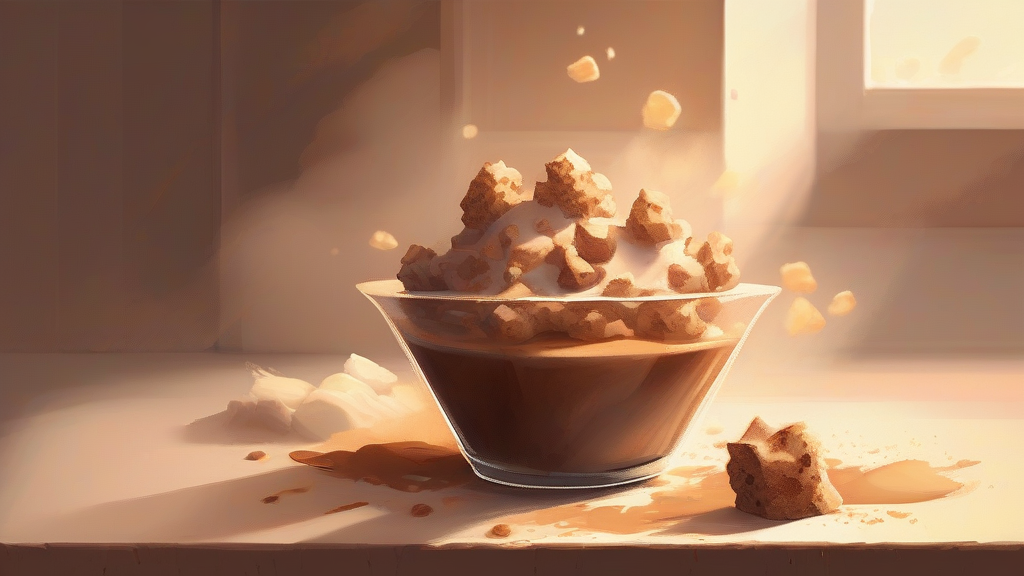
What does crumble mean?
Crumble is a verb describing the process of breaking apart into small fragments or crumbs. It applies literally to physical substances — bread, biscuits, masonry, cliffs — and figuratively to things that weaken or fall apart over time: marriages, economies, confidence, reputations. A building crumbles from neglect; a person may crumble under pressure. In British English, crumble is also a noun denoting a beloved home-style dessert in which stewed fruit is baked beneath a topping of flour, butter, and sugar rubbed together into coarse crumbs, typically served hot with custard. The word derives from Middle English 'cromelen', a frequentative form related to 'crumb', tracing back through Old English 'cruma'. Evocative and versatile, crumble captures both gentle physical disintegration and the quieter collapse of abstract things, which makes it a favourite of journalists and novelists alike.
To break or fall apart into small crumbs or fragments, either physically or figuratively.
"The ancient frescoes were crumbling off the chapel walls."
Often used figuratively in journalism and literature for gradual institutional decline.
(British) A baked dessert consisting of stewed fruit covered with a crumbly topping of flour, butter, and sugar.
"For pudding we had gooseberry crumble with thick cream."
Chiefly British and Commonwealth; American equivalents include 'crisp' and 'cobbler' variants.
Applies only to the dessert sense of the noun; the verb has no plural.
"The café sells apple and rhubarb crumbles by the slice."
Before it meant falling apart, 'crumble' simply meant making crumbs — it grew out of the same Old English word that gives us 'crumb'.
Reviewed by Deb Chak, Editor. AI-assisted content curated by RJS Tech Solutions LLP.
Etymology of crumble
The verb crumble comes from Middle English 'cromelen', a frequentative form derived from 'crome', meaning crumb, which itself descends from Old English 'cruma'. Frequentative formation suggests repeated action — reducing something to crumbs bit by bit. Its Germanic relatives include Dutch 'kruimel' and German 'Krümel' (little crumb), all stemming from a common Germanic root. The dessert sense arose in twentieth-century Britain, while the figurative sense of institutions or resolve crumbling developed naturally from the physical one.
Related word forms
How crumble is actually used
As a verb, 'crumble' is common in both literal and figurative registers, though the figurative use (empires crumble, resolve crumbles) carries a slightly literary tone. The noun sense — the fruit dessert — is chiefly British and Commonwealth usage; Americans more often say 'fruit crisp', which uses a similar topping with oats.
Easily confused with crumble
To crumble is to break into small fragments or crumbs, while to crumple is to crush into wrinkles or folds, as paper or fabric.