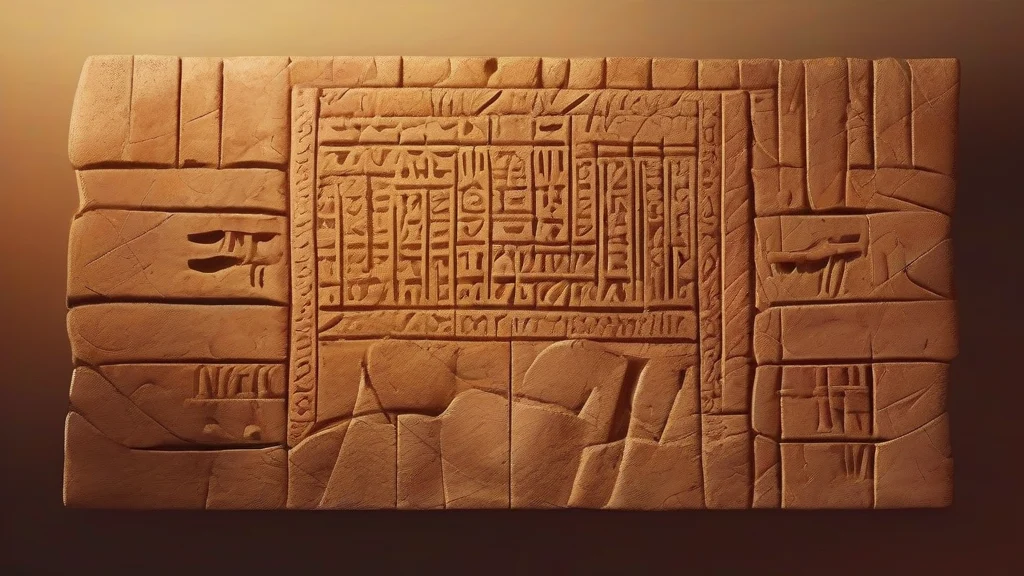
What does cuneiform mean?
Cuneiform is best known as the world's earliest known system of writing, developed in ancient Mesopotamia more than five thousand years ago. Rather than being drawn with pen and ink, it was produced by pressing wedge-shaped marks into damp clay tablets using a cut reed stylus, then leaving them to dry or baking them hard. Used across millennia by Sumerians, Akkadians, Babylonians, Assyrians, and others, cuneiform recorded everything from grain accounts to epic poetry such as the Epic of Gilgamesh. The word also functions as an adjective describing anything wedge-shaped or relating to this script, including certain small bones in the human wrist and foot named for their form. Because the tablets survive so well, cuneiform remains central to our understanding of early civilization, and its gradual decipherment in the nineteenth century opened a direct window onto the ancient world.
The system of writing used in ancient Mesopotamia, consisting of wedge-shaped impressions made in clay tablets with a stylus.
"The museum's collection includes thousands of cuneiform tablets dating back to the third millennium BCE."
Usually treated as singular when referring to the script as a whole.
Wedge-shaped, or composed of or relating to wedge-shaped characters such as those of the Mesopotamian script.
"Anatomy students memorise the three cuneiform bones of the midfoot alongside the navicular and cuboid."
Rarely pluralized when referring to the script itself, which is usually treated as uncountable; the plural occurs mainly in anatomy, referring collectively to cuneiform bones.
"Both the medial and intermediate cuneiforms articulate with the second metatarsal."
Cuneiform was pressed into wet clay over 5,000 years ago — making it humanity's earliest known system of writing, and one you can still read today if you learn the wedges.
Reviewed by Deb Chak, Editor. AI-assisted content curated by RJS Tech Solutions LLP.
Etymology of cuneiform
The word cuneiform derives from the Latin cuneus, meaning "wedge," combined with forma, meaning "shape" — literally "wedge-shaped." It entered English in the late seventeenth century, originally as a general descriptive term for wedge-shaped things, before becoming firmly attached to the Mesopotamian script during the eighteenth and nineteenth centuries as scholars worked to decipher it. It shares its Latin root with the anatomical terms cuneate and cuneal, both of which also describe wedge-shaped structures.
How cuneiform is actually used
"Cuneiform" as a noun typically takes no plural in ordinary use when referring to the script as a whole, though "cuneiforms" appears in specialized anatomical contexts referring to cuneiform bones of the wrist and foot. The word carries a scholarly, historical register and is rarely used casually outside discussions of antiquity, archaeology, or anatomy.
Easily confused with cuneiform
Hieroglyphic refers to the pictorial writing system of ancient Egypt, whereas cuneiform is the wedge-impressed writing of ancient Mesopotamia.
Cuneate is a technical term meaning simply wedge-shaped (as in botany or anatomy), while cuneiform most often denotes the ancient Mesopotamian script itself.