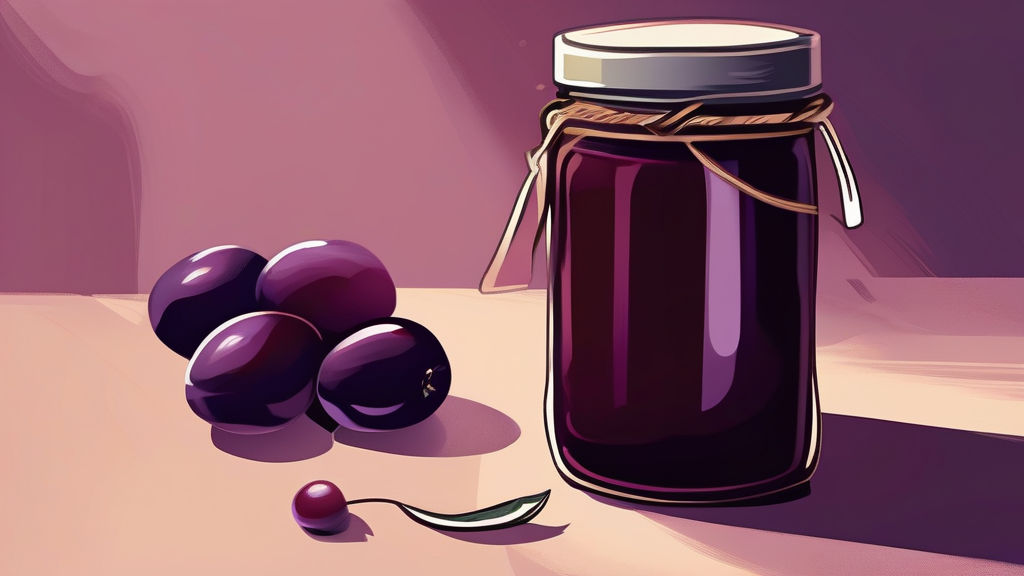
What does damson mean?
A damson is a small, oval fruit of the plum family, prized for its deep blue-black or purple skin and golden-yellow flesh. Sharper and less sweet than ordinary plums, damsons are seldom eaten raw; instead they are transformed into jams, jellies, pies, chutneys, and traditional British liqueurs such as damson gin. The word also denotes the compact, hardy tree that bears them, a close relative of the bullace and the sloe of blackthorn fame. Damsons are especially associated with Britain — where varieties like the Shropshire Prune have been grown for centuries — though their name points eastward, deriving ultimately from Damascus. In usage, "damson" carries a homely, seasonal connotation, evoking late-summer harvests, stained fingers, and country kitchens. It appears most often as an uncountable mass noun when referring to the cooked fruit ("a pot of damson") and as a countable noun when referring to individual plums or the tree itself.
A small, dark-purple European plum with tart yellow-green flesh, used mainly in jams, preserves, and desserts.
"We gathered enough damsons from the hedge to fill three jars with jam."
Often treated as a mass noun in culinary contexts ("damson jam"); the plural "damsons" refers to individual fruits.
The small, hardy tree (Prunus domestica subsp. insititia) that bears the damson plum.
"An ancient damson shaded the corner of the walled garden."
Usually preceded by an article or modifier when referring to the tree ("a damson tree").
The plural "damsons" refers to individual fruits or to multiple trees. In cooking contexts, the singular mass-noun form is also common ("a pound of damson").
"The market stall was piled high with ripe damsons in early September."
The humble British damson takes its name from ancient Syria — its full Latin name means "plum of Damascus" — yet it has become one of England's most beloved hedgerow fruits.
Reviewed by Deb Chak, Editor. AI-assisted content curated by RJS Tech Solutions LLP.
Etymology of damson
The word "damson" derives from the Latin phrase pruna damascena, meaning "plums of Damascus," reflecting the fruit's association with the Syrian capital. It entered English through the Old French form damascene, which was gradually worn down into the Middle English forms "damesene" and eventually "damson." The same place-name root gives us "damask" and "damascene," making these true etymological cousins of the fruit.
How damson is actually used
Chiefly used in British English, where damsons are a familiar feature of gardens, hedgerows, and autumn cookery; in American English the word is less common but understood. The fruit's natural sourness means it is rarely eaten raw and is usually sweetened in cooking.
Easily confused with damson
"Damson" names a tart variety of plum, while "damask" refers to a patterned woven fabric or a type of rose named after Damascus.
"Damascene" describes something from or characteristic of Damascus (or a sudden conversion), whereas "damson" is simply a small purple plum.