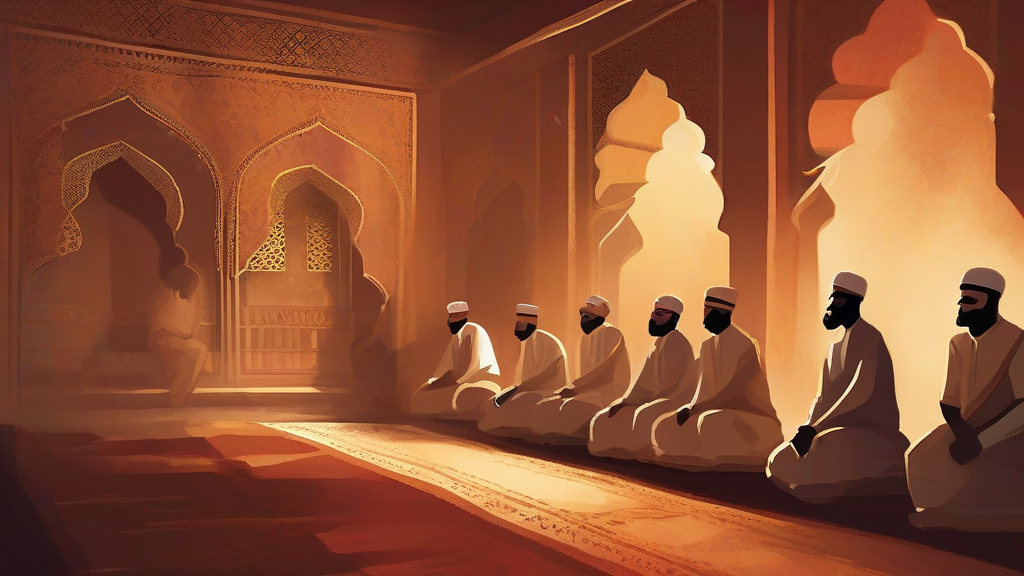
What does darbar mean?
A darbar is a formal court or ceremonial assembly convened by an Indian ruler, at which the sovereign granted audiences, received petitions, and conducted affairs of state before officials, nobles, and subjects. The word also denotes the hall or chamber in which such a court met. Borrowed into European languages during the era of British involvement in India, it appears frequently in historical accounts of the Mughal empire and the princely states, where durbars were occasions of considerable pomp — processions, tributes, and displays of allegiance. In modern usage the term survives chiefly in historical, literary, and cultural contexts, sometimes applied metaphorically to any imposing official gathering. Its connotations are those of majesty, hierarchy, and tradition, making it a useful and evocative word for describing the ritualized exercise of power in South Asian history.
nounA court or formal assembly held by an Indian ruler or nobleman, especially one at which state business was conducted or audiences were granted. More broadly, the hall or chamber in which such a court is held.
- A ceremonial court or public assembly held by an Indian ruler, at which audiences were granted and state affairs conducted.
- The hall or chamber in which such a court is held.
"The maharaja received the British envoy with full ceremony at his darbar."
"Thousands gathered to witness the emperor's darbar during the festival."
"The petitioners waited outside the darbar hall for their turn to address the ruler."
Standard plural; both "darbars" and "durbars" appear depending on spelling convention.
"The chronicles describe the lavish durbars held during the emperor's reign."
The word for a king's grand court comes from Persian words meaning simply 'door' and 'house' — a royal audience was literally a matter of standing at the ruler's threshold.
Reviewed by Deb Chak, Editor. AI-assisted content curated by RJS Tech Solutions LLP.
Etymology of darbar
The word derives from Persian "darbār", a compound of "dar" ("door, gate") and "bār" ("entry, audience"), originally denoting admittance to a ruler's presence and by extension the court itself. It entered English during the period of British engagement with India, transmitted through Urdu and Hindi usage, and was long spelled "durbar" in colonial writing. Related Persian-derived terms in South Asian usage include "dargah" and "subadar", which share elements of the same linguistic heritage.
How darbar is actually used
The word carries historical and cultural weight, evoking Mughal and princely India; it is most often encountered in historical writing about South Asia, where the variant spelling "durbar" is also common.
Easily confused with darbar
"Durbar" is simply the more common anglicized spelling of the same word, borrowed through Urdu/Persian into colonial-era English; "darbar" reflects the South Asian pronunciation more directly.