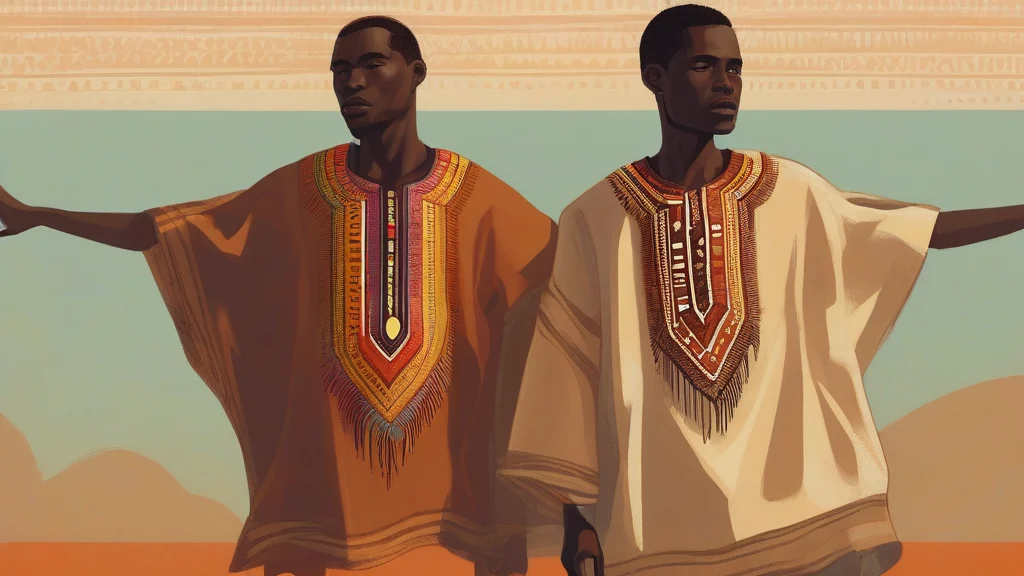
What does dashiki mean?
A dashiki is a brightly colored, loosely fitting garment originating in West Africa, most closely associated with Yoruba culture in Nigeria. Typically worn as a pullover tunic by men, it features a V-shaped or round neckline decorated with elaborate embroidery, often in contrasting thread. The word entered English in the twentieth century as African fashion spread internationally. In the United States during the 1960s and 1970s, the dashiki became a powerful symbol of Black pride and cultural identity, adopted by activists, musicians, and anyone embracing African heritage. Today it appears both as everyday traditional attire across parts of West Africa and as celebratory or formal wear worldwide, especially at weddings, festivals, and cultural observances such as Kwanzaa. Bold patterns, vivid colors, and comfortable cuts make it instantly recognizable, and it remains an enduring emblem of African diasporic style and self-expression.
nounA brightly colored, loosely fitting pullover shirt or tunic of West African origin, typically embroidered at the neckline and worn by men.
- A brightly colored, loosely fitting West African pullover tunic with decorative embroidery around the neckline, traditionally worn by men.
"He wore a vibrant yellow dashiki with intricate embroidery to the festival."
"For the Kwanzaa celebration, the whole family wore matching dashikis in bold red and green."
"The musician stepped on stage in a flowing purple dashiki that caught the stage lights beautifully."
Both the regular plural 'dashikis' and the unchanged form 'dashiki' are used; 'dashikis' is more common in everyday English.
"Several dancers wore brightly colored dashikis during the performance."
The dashiki went from everyday West African wear to a global emblem of Black pride during the American civil rights era of the 1960s.
Reviewed by Deb Chak, Editor. AI-assisted content curated by RJS Tech Solutions LLP.
Etymology of dashiki
The word 'dashiki' comes from the Yoruba language of Nigeria, where 'dàńṣíkí' refers to this type of garment. It was borrowed into English during the mid-twentieth century as West African clothing gained international visibility. Its rise in American English coincided with the civil rights movement, when the garment itself became a symbol of Black cultural pride. The term has no Indo-European cognates, being a direct loan from Yoruba.
How dashiki is actually used
Often capitalized informally; strongly associated with African heritage, cultural pride, and 1960s–70s counterculture fashion in the United States. Wearing one can signal solidarity with African identity or be part of traditional dress at weddings, festivals, and religious occasions.
Easily confused with dashiki
A kaftan is a similar loose garment but derives from the Middle East via Turkish or Persian tradition and is worn by both sexes, whereas a dashiki specifically comes from West Africa and is characteristically a pullover tunic.