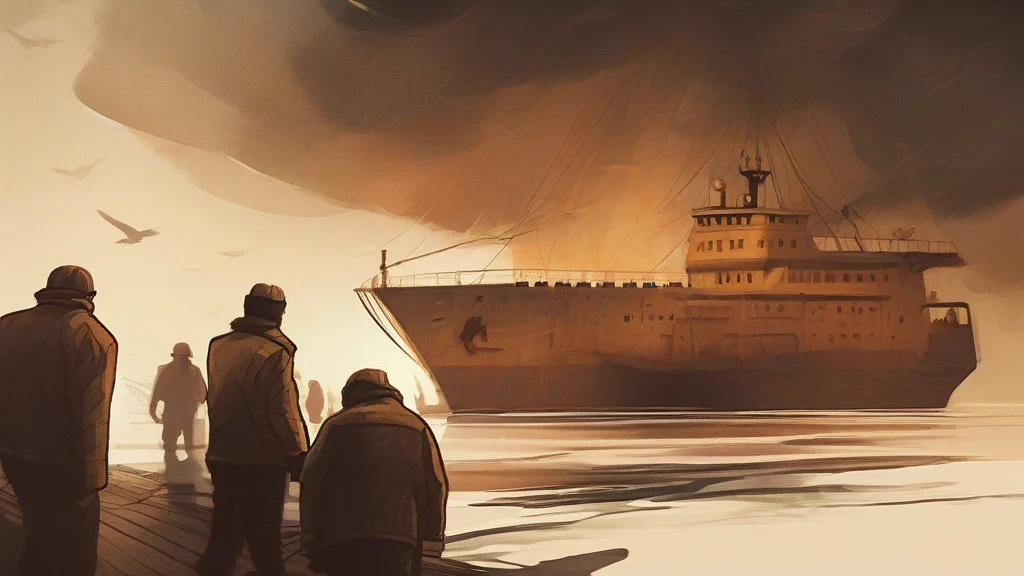
What does debarkation mean?
Debarkation is the formal term for the process of leaving a ship or aircraft and setting foot on land, or of unloading people and cargo from a vessel. It is most often heard in military, naval, and official travel contexts — troop debarkations, debarkation ports, and designated debarkation points are standard phrases in logistics and operational planning. The word carries a technical, institutional tone rather than a casual one; an ordinary traveler would more likely say they were getting off the plane, while an airline might announce disembarkation procedures. Debarkation contrasts directly with embarkation, which describes boarding rather than leaving a craft. Its roots lie in the Latin word for 'bar' — the same root that gives us 'barrier' and 'barge' — via Old French and Spanish seafaring vocabulary. For readers interested in maritime history, migration, or military operations, it is a precise and useful term for describing the moment a journey by sea or air ends and a presence ashore begins.
The act of disembarking from a ship or aircraft, especially of troops or passengers going ashore.
"The debarkation began at first light, with landing craft ferrying men to the beach."
Preferred over 'disembarkation' in much US military doctrine.
The unloading of cargo from a ship or other vehicle.
"Customs officials supervised the debarkation of the container shipment."
Usually treated as a mass noun referring to a single process; the plural appears when discussing multiple separate events.
"The harbor saw several major troop debarkations during the war."
Before World War II planners standardized the term, soldiers were just as likely to 'land' as to 'debark' — but D-Day made debarkation points a matter of global history.
Reviewed by Deb Chak, Editor. AI-assisted content curated by RJS Tech Solutions LLP.
Etymology of debarkation
Debarkation derives from the verb 'debark', which entered English in the early 17th century, formed on the prefix 'de-' (indicating removal) plus 'bark', a word for a small sailing ship. That 'bark' traces back through Old French 'barque' to Latin 'barca', related to 'barra', meaning bar — the same root underlying 'barrier', 'embargo', and 'barge'. The noun 'debarkation' followed the verb, and its sense of troops going ashore became especially prominent in 20th-century military usage.
Related word forms
How debarkation is actually used
Formal and somewhat technical in register; commonest in military, maritime, and official travel contexts. In everyday speech, 'disembarkation' is more frequent, though 'debarkation' is standard terminology in US military usage for troops going ashore.
Easily confused with debarkation
Embarkation is the act of boarding a ship or aircraft, whereas debarkation is the act of leaving it.