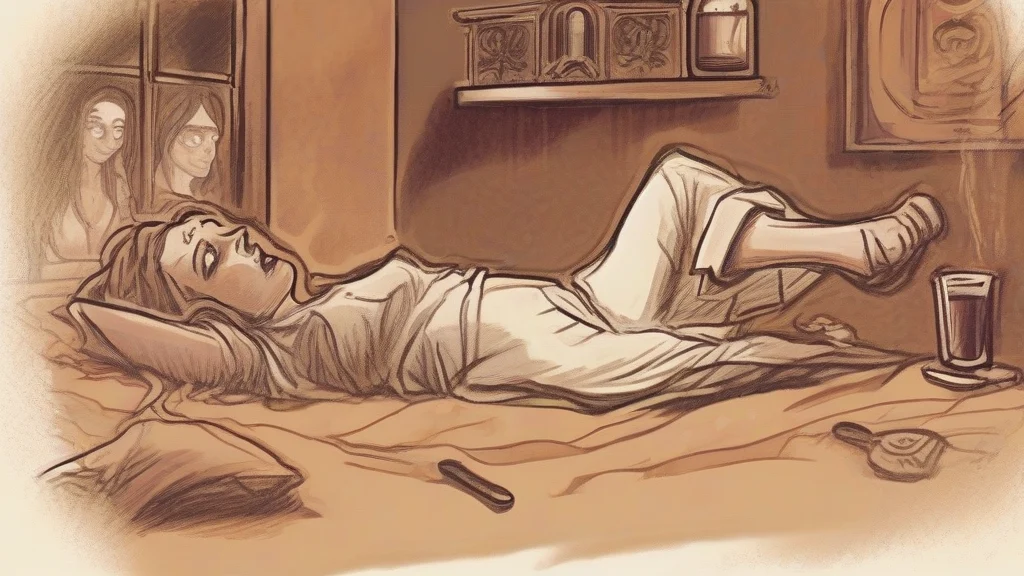
What does debauchery mean?
Debauchery refers to excessive indulgence in sensual pleasures — above all heavy drinking and sexual activity — carried to a degree regarded as morally degrading or physically destructive. The word functions as a formal, literary noun with strongly negative connotations: it does not simply describe pleasure-seeking, but implies a loss of restraint that damages character, health, or reputation. One might speak of 'a life of debauchery,' 'drunken debauchery,' or 'a night of debauchery,' and it appears most often in historical accounts, moral criticism, and fiction portraying dissolute aristocrats, decadent empires, or wayward heirs. Related forms include the verb 'to debauch' (to corrupt or lead astray) and the noun 'debauchee' (the person so engaged). Etymologically it traces to the French 'débaucher,' meaning to entice someone away from duty or work, which itself may derive from an image of drawing a worker off the job. Because of its vivid moral weight, debauchery remains a striking and useful word for condemning excess in elevated prose.
nounExcessive indulgence in sensual pleasures, especially drinking, sex, and other physical gratifications, typically to the point of self-degradation or moral ruin.
- Habitual or excessive indulgence in sensual pleasures, especially drinking and sexual activity, regarded as morally degrading.
- A specific occasion or period of such wild, unrestrained indulgence.
"The young aristocrat squandered his inheritance on a decade of wine, gambling, and debauchery."
"The novel chronicles the protagonist's slow descent into gambling and debauchery."
"After the wedding, a night of unashamed debauchery left the entire party exhausted."
Rarely pluralized; the singular is standard even for repeated episodes. A plural form exists but is chiefly found in older or highly literary prose.
"His memoirs recount the debaucheries of his youth with surprising candor."
The word 'debauchery' comes from a French verb literally meaning to lead someone astray — originally used for luring workers away from a job, before it came to mean luring souls away from virtue.
Reviewed by Deb Chak, Editor. AI-assisted content curated by RJS Tech Solutions LLP.
Etymology of debauchery
Debauchery entered English in the early 17th century from the French verb 'débaucher,' meaning to entice or lead someone astray, particularly to draw a worker away from his employment. The French word likely derives from 'des-' (apart) combined with 'bauche,' a term of uncertain origin possibly related to a workshop or place of work. From this sense of leading people away from duty came the broader sense of leading them into moral corruption and sensual excess. English cognates include the direct borrowings 'debauch' and 'debauchee.'
Related word forms
How debauchery is actually used
Debauchery is a formal or literary noun carrying strongly negative, judgmental connotations — it implies not merely enjoyment but excess that corrupts character. It is common in historical writing, moral commentary, and fiction describing dissolute lifestyles, but rare in casual everyday speech.
Easily confused with debauchery
'Debauch' is the verb (or noun meaning an episode of such indulgence) from which 'debauchery' derives; 'debauchery' is specifically the noun for the habitual behavior itself.
A 'debauchee' is the person who engages in debauchery, while 'debauchery' names the conduct.