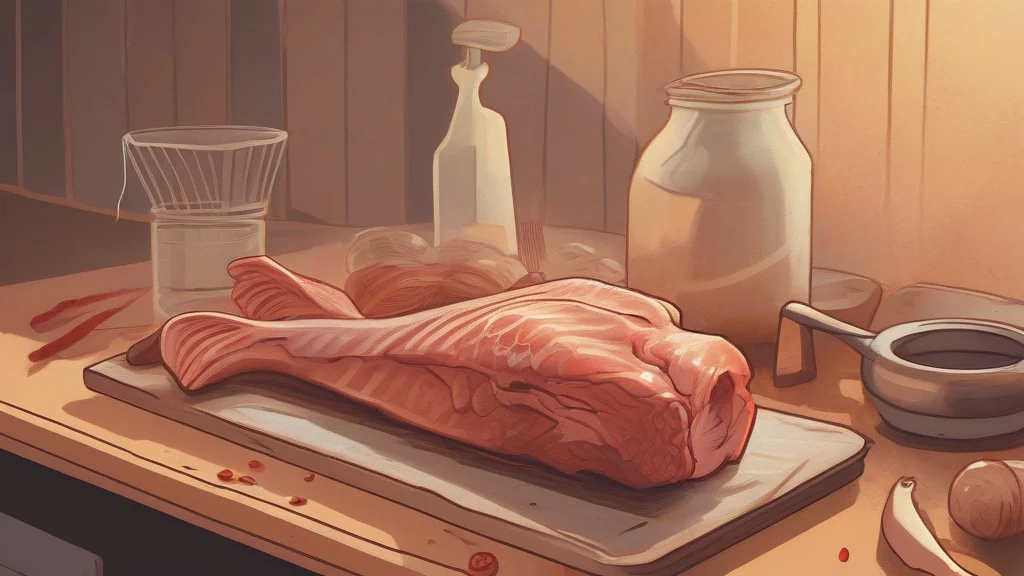
What does deboning mean?
Deboning is the process of removing bones from meat, poultry, or fish, whether before cooking, during preparation, or at the table. It is a fundamental skill in professional kitchens, where chefs use specialized tools such as the flexible-bladed deboning knife to work closely around joints and along rib cages with minimal waste. The term functions chiefly as a noun for the activity itself ('deboning takes patience') and derives from the verb 'debone'. Cooks debone poultry to produce rolled roasts and stuffed birds, fillet fish, and trim beef or pork cuts for even cooking and easier eating. While home cooks once left such tasks to their butcher, deboning has become increasingly popular among enthusiasts seeking whole-animal cooking skills and better value from entire birds or fish. Related techniques include filleting, butterflying, and spatchcocking.
The act or process of removing bones from meat, fish, or poultry.
"Careful deboning of the leg of lamb left the meat ready for butterflying and stuffing."
An uncountable noun describing the activity; it does not take a plural.
Present participle of 'debone': to remove the bones from meat, fish, or poultry.
"She was deboning quail for the first course when the order tickets started printing."
A skilled butcher can debone an entire chicken in under two minutes — and the French call the result a bird cooked 'en crapaudine', flattened like a toad.
Reviewed by Deb Chak, Editor. AI-assisted content curated by RJS Tech Solutions LLP.
Etymology of deboning
Deboning derives from the verb 'debone', a modern English formation using the prefix 'de-' (indicating removal) attached to the noun 'bone'. 'Bone' itself comes from Old English 'bān', a common Germanic word with cognates in other early Germanic languages, though its ultimate pre-Germanic origins remain uncertain. The verb 'debone' arose relatively recently in American English, largely in culinary contexts, alongside parallel formations like 'de-ice' and 'defrost'. Cognate terms built on the same root include 'bony' and 'boneless', while older compounds such as 'bonfire' reflect the long history of 'bone' in English vocabulary.
Related word forms
How deboning is actually used
Primarily used in professional and instructional cooking contexts. The shorter form 'boning' is equally common among butchers and cooks; 'deboning' tends to appear more often in consumer-facing recipes and cookbooks.
Easily confused with deboning
Disjointing separates a carcass at its joints into pieces without necessarily removing any bones, whereas deboning removes the bones themselves.