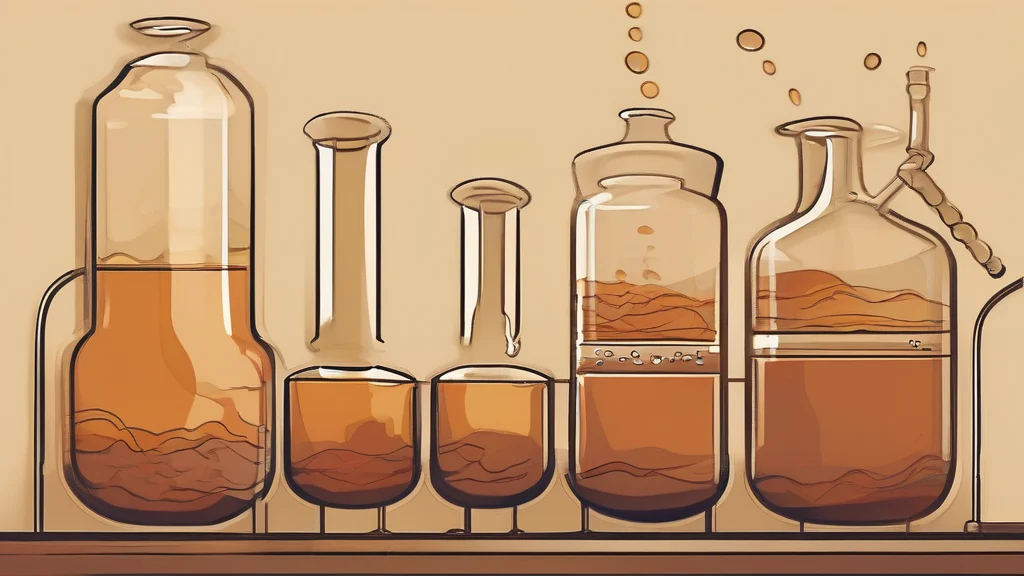
What does decantation mean?
Decantation is the process of gently pouring a liquid from one container into another so that any solid matter — sediment, dregs, or precipitate — is left behind. The word is most familiar from the world of wine, where decantation serves two purposes: separating older wines from the bitter sediment that settles in the bottle, and aerating younger, tannic wines to soften their flavour. In chemistry and industry, the term has a more technical sense, describing a method of separating mixtures by letting solids settle and then drawing off the clear liquid above them, as opposed to filtering. Derived ultimately from Latin roots meaning to tip out by the edge, decantation carries a slightly formal register; everyday speakers tend to prefer 'decanting' or 'pouring'. Whether in a dining room or a laboratory, the underlying idea is the same: separation achieved not by straining but by patience and a careful, unhurried pour.
The process of pouring a liquid from one container to another, leaving sediment or other solid material behind.
"The decantation of the vintage port took several minutes and required a candle to illuminate the bottle's shoulder."
Most commonly encountered in wine contexts; also standard terminology in chemistry for separating liquids from settled solids.
In chemistry, a method of separating a mixture by allowing the heavier component to settle and then pouring off the lighter, supernatant liquid.
"Decantation proved faster than filtration for removing the coarse precipitate from the reaction mixture."
Rarely used in the plural; the uncountable singular form is standard, since the process is normally referred to generically.
"Repeated decantations were necessary to achieve a fully clarified liquid."
The word decantation comes from Latin de- ('off') plus cantare ('to pour edge-wise') — so when you decant wine, you are literally tipping it gently over the edge, just as the Romans did.
Reviewed by Deb Chak, Editor. AI-assisted content curated by RJS Tech Solutions LLP.
Etymology of decantation
Decantation derives from the verb 'decant', which entered English around the early 17th century from French 'décanter'. The French word traces back through Provençal to Medieval Latin 'decanthare', formed from 'de-' ('off, away') plus 'canthus' ('edge, rim'), ultimately from Greek 'kanthos' meaning the corner of the eye or a projecting edge. The original sense was thus to tip a liquid out over the edge of its vessel, and the noun 'decantation' developed alongside the verb to name the process itself.
Related word forms
How decantation is actually used
Decantation is a formal, technical-sounding noun; in everyday speech people usually say 'decanting' or simply 'pouring'. It is standard in wine writing and scientific contexts alike, with no notable regional variation between British and American English.
Easily confused with decantation
A decanter is the vessel used for holding the poured liquid, while decantation is the act or process of pouring itself.