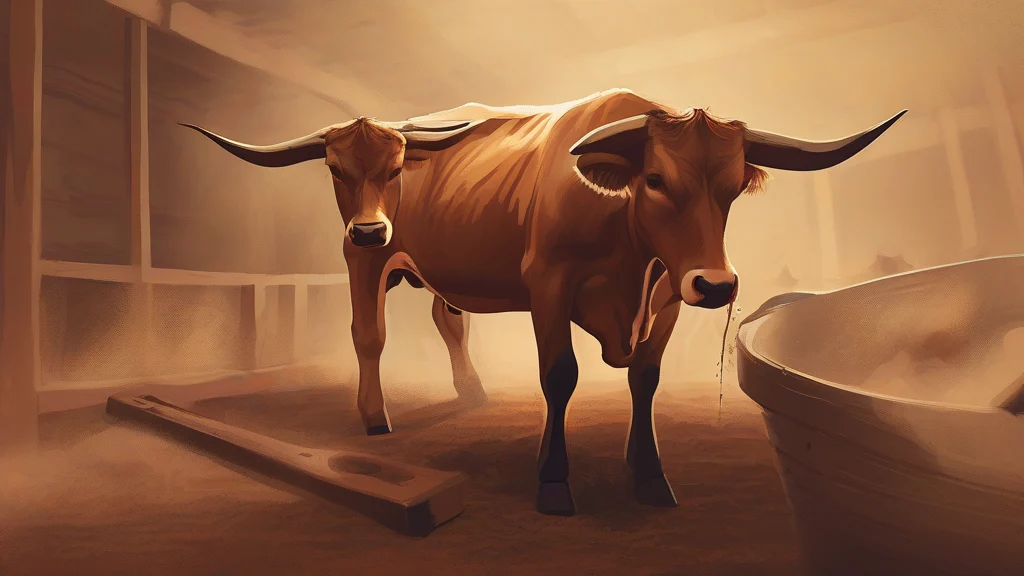
What does dehorning mean?
Dehorning is the agricultural and veterinary practice of removing the horns of livestock, most commonly cattle and goats. Horns are bony structures firmly attached to the skull, so removing them from mature animals is genuine surgery, usually carried out with saws, shears, or hot-iron cautery — ideally with anaesthesia and analgesia under modern welfare standards. Farmers dehorn mainly to protect handlers and other animals from injury and to reduce bruising during transport and handling. Because of the pain involved, many producers prefer disbudding, which destroys the horn bud in very young calves before it fuses to the skull. The word appears chiefly in technical, regulatory, and animal-welfare writing, where debates over humane methods keep it current. A rarer figurative sense describes stripping a person or institution of power, as though disarming a dangerous beast.
nounThe practice or act of removing the horns of livestock, especially cattle, typically by sawing, clipping, or caustic treatment.
- The removal of horns from livestock such as cattle or goats, done by physical means (sawing, clipping) or chemical cauterisation.
- (Figurative/rare) The act of depriving something or someone of its power or defences, by analogy with disarming an animal.
"The veterinarian performed the dehorning while the calves were still young to minimise stress."
"Welfare regulations now require pain relief during dehorning on most commercial farms."
"The new chairman set about the dehorning of the company's most powerful regional managers."
Rarely pluralised; the noun is almost always treated as uncountable, referring to the practice rather than individual instances.
"Several dehornings were carried out that season under veterinary supervision."
A cow's horns are living bone fused to her skull — which is why farmers race to remove the tiny 'bud' early, before dehorning becomes true surgery.
Reviewed by Deb Chak, Editor. AI-assisted content curated by RJS Tech Solutions LLP.
Etymology of dehorning
Dehorning derives from the verb dehorn, formed in English from the prefix de- (indicating removal) plus horn, a native Germanic word traceable through Old English 'horn' back to Proto-Germanic *hurną. It shares this distant root with Latin cornu and Greek keras, which give English cognates such as unicorn ('one horn'), rhinoceros ('nose-horn'), and keratin, the protein of which horn is largely composed. The verb has been in use since at least the early modern period, with the noun dehorning following as its action form.
Related word forms
How dehorning is actually used
Primarily a technical term used in veterinary science, agriculture, and animal-welfare contexts. Because it involves cutting bone-attached tissue, it carries welfare connotations and is increasingly regulated; many jurisdictions encourage disbudding young calves instead. A figurative use exists but is rare.
Easily confused with dehorning
Disbudding removes the horn buds of very young calves before they attach to the skull, whereas dehorning removes fully grown or attached horns from older animals.