What does demolished mean?
Demolished is the past tense and past participle of the verb 'demolish', meaning torn down or destroyed entirely. Its most concrete sense applies to buildings and structures: a house is demolished to clear land for construction, or a crumbling bridge is demolished for safety reasons. The word extends naturally into figurative territory, where it describes overwhelming defeat — a sports team may be demolished by its opponents, or a speaker's argument may be demolished by devastating evidence. In all uses it conveys totality and finality; something demolished is not merely damaged but reduced essentially to nothing. The term is neutral in register, appearing everywhere from planning documents to match reports, though its figurative uses tend toward vivid, emphatic language. It derives ultimately from the Latin 'demoliri', formed from 'de-' and 'moliri' (to build or construct), so the word's history contains an ironic reversal: it names the undoing of the act of building itself. Related forms include 'demolition', 'demolisher', and 'demolitionist', each extending the core idea of complete destruction into different grammatical and social contexts.
Past tense and past participle of 'demolish': tore down or destroyed completely; figuratively, defeated or refuted utterly.
"The stadium was demolished to make room for housing."
Also used passively ('was demolished'), where it functions adjectivally in sense.
Having been torn down or destroyed; also, figuratively, having suffered total defeat.
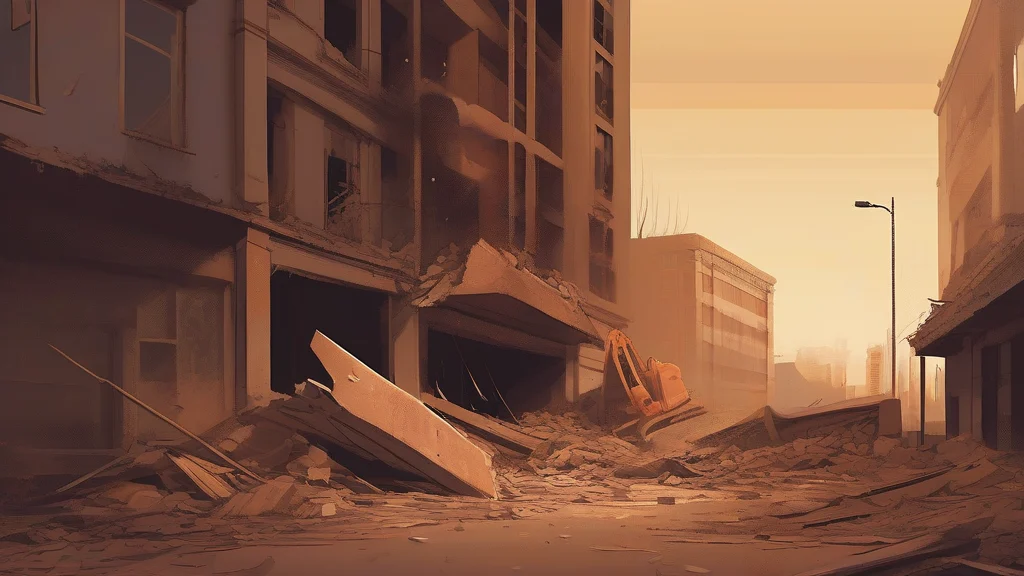
"The demolished warehouse left a gaping hole in the street's skyline."
The adjectival use is common in passive constructions and attributive positions.
When a critic says your argument was 'demolished', they're borrowing a word whose Latin ancestor literally meant to heap up a massive pile — of rubble.
Reviewed by Deb Chak, Editor. AI-assisted content curated by RJS Tech Solutions LLP.
Etymology of demolished
Demolished comes from the verb 'demolish', which English adopted in the sixteenth century from French 'démolir', itself from Latin 'demoliri', meaning to tear down or throw down. The Latin word combines the prefix 'de-' (indicating removal or reversal) with 'moliri', to build or construct, a verb rooted in the noun 'moles', meaning a mass or massive structure. This makes the word's history strikingly self-aware: to demolish is, etymologically, to un-build what has been built. Cognates and relatives include the noun 'demolition', which entered English slightly later, and other formations such as 'demolisher' and 'demolitionist'.
Related word forms
How demolished is actually used
Register is neutral; 'demolished' works equally in formal journalism and casual speech. In its figurative senses it carries a forceful, sometimes hyperbolic tone — a team or argument that was merely beaten or questioned is not usually described as 'demolished'.