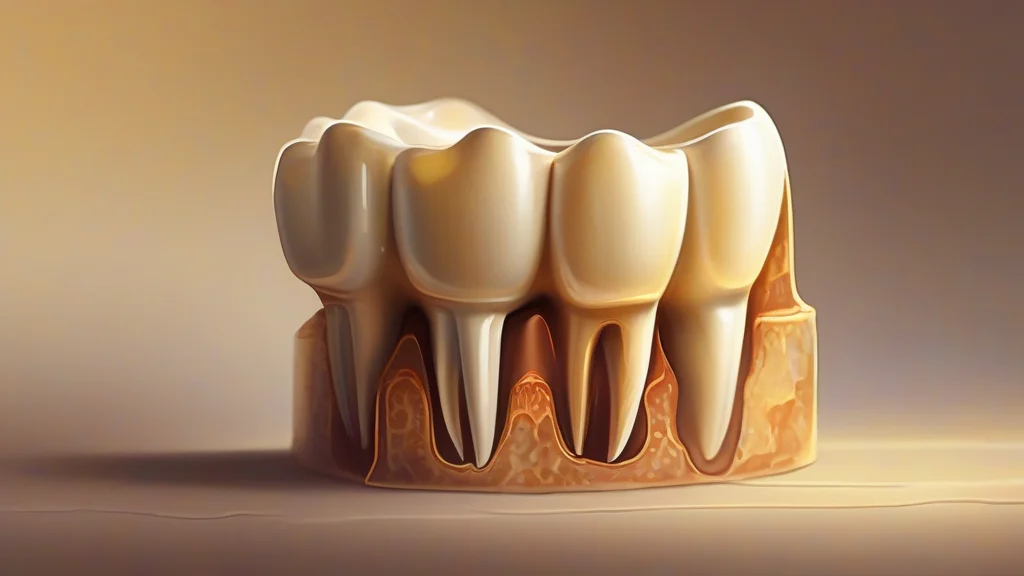
What does dentine mean?
Dentine is the hard, dense tissue that forms the bulk of every tooth, lying directly beneath the protective outer layer of enamel and enclosing the soft pulp at the tooth's core. Slightly softer than enamel but far tougher than it appears, dentine gives teeth their resilience and accounts for much of their characteristic yellowish hue when enamel wears thin. Because dentine contains microscopic tubules connected to the nerve-rich pulp, its exposure through gum recession or erosion is a leading cause of tooth sensitivity — a fact familiar to anyone who winces at ice water. The word belongs chiefly to the vocabulary of dentistry, anatomy, and palaeontology, where it is indispensable for describing tooth structure and diagnosing decay. Its variant spelling, dentin, is standard in American English. Beyond human teeth, dentine also constitutes animal tusks, making it the substance of commercial ivory — an association that has given the word unexpected cultural and legal weight.
nounThe hard, bone-like tissue that forms the main body of a tooth beneath the enamel and surrounds the pulp chamber. It is yellowish in colour and is produced by cells called odontoblasts.
- The calcified tissue forming the bulk of a tooth beneath the enamel.
- A similar material found in the tusks or teeth of animals, including ivory.
"As the enamel wore away, the exposed dentine gave his teeth a yellowish tint."
"When decay penetrates the enamel, it reaches the dentine and the tooth becomes sensitive to hot and cold."
"Fossil hunters identified the specimen as a tooth because of the distinctive banding pattern in its dentine."
Rarely pluralised; the uncountable form is standard even when referring to multiple teeth.
"Sections of dentines from different species were compared under the microscope."
Ivory — prized for piano keys and carvings for millennia — is essentially just dentine from elephant tusks.
Reviewed by Deb Chak, Editor. AI-assisted content curated by RJS Tech Solutions LLP.
Etymology of dentine
Dentine derives from the Latin dens (genitive dentis), meaning "tooth", combined with the French-derived suffix -ine denoting a substance. The term entered English in the early 19th century via French anatomical vocabulary. It shares this Latin root with a family of tooth-related words, including dentist, dental, denture, and trident.
How dentine is actually used
Primarily used in dentistry, anatomy, and palaeontology. The American spelling is typically "dentin" without the final -e. It carries no figurative or informal usage.
Easily confused with dentine
"Dentin" is simply the American spelling variant of "dentine", not a different word — both refer to the same tooth tissue.