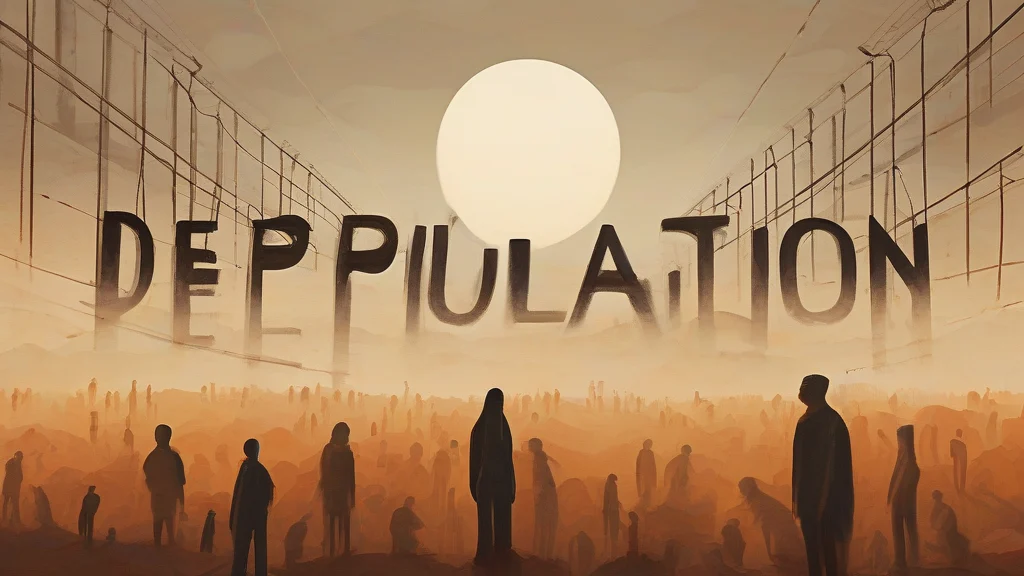
What does depopulation mean?
Depopulation refers to the reduction or disappearance of a population from a given area — a town, region, or entire country. The word is most often used to describe a gradual demographic decline driven by factors such as emigration, low birth rates, ageing populations, economic collapse, or environmental hardship, though it can also denote the abrupt loss of inhabitants through war, plague, or forced displacement. In modern usage, it appears frequently in discussions of rural communities losing residents to cities, as well as in debates about countries such as Japan and Italy whose birth rates have fallen below replacement level. The term carries a largely negative connotation, suggesting emptiness, abandonment, or social and economic distress. As a formal noun derived from the verb 'depopulate', it belongs chiefly to academic, governmental, and journalistic writing rather than casual conversation.
nounThe reduction or decline of a population in a region, country, or settlement, typically through emigration, low birth rates, disease, war, or famine. It can also refer historically to the deliberate removal of inhabitants from an area.
- The decline in the number of people living in a particular area, whether gradual or sudden.
- (Historical) The forced removal or killing of inhabitants from a region, as in warfare or colonial policy.
"The depopulation of the village accelerated after the closure of its only factory."
"Rural depopulation has left many farming communities struggling to maintain basic services."
"The war resulted in the near-total depopulation of several coastal towns."
Rarely used in the plural; the uncountable singular form is standard in nearly all contexts. A plural may occasionally appear in demographic literature referring to multiple distinct regional declines.
"The report compared rural depopulations across three European countries."
Japan's population has been shrinking for over a decade — entire villages have vanished, leaving 'ghost towns' where schools outnumber children.
Reviewed by Deb Chak, Editor. AI-assisted content curated by RJS Tech Solutions LLP.
Etymology of depopulation
Depopulation derives from the Latin root populus, meaning 'people' or 'a nation', combined with the prefix de- (removal or reversal). The word entered English via the verb 'depopulate' in the late 16th or early 17th century, with 'depopulation' following shortly after. It shares this Latin ancestry with cognates such as 'population', 'populate', and 'popular', all of which trace back through Old French to populus.
Related word forms
How depopulation is actually used
Formal register; common in academic, journalistic, and demographic contexts. Often carries negative connotations, implying loss, abandonment, or crisis. Frequently used with modifiers like 'rural', 'rapid', or 'widespread'.
Easily confused with depopulation
Deforestation refers to clearing forests of trees, whereas depopulation refers to removing people from an area.
Deportation is the forced expulsion of specific individuals from a country by legal authority, while depopulation is a broader demographic decline that may occur naturally or deliberately.