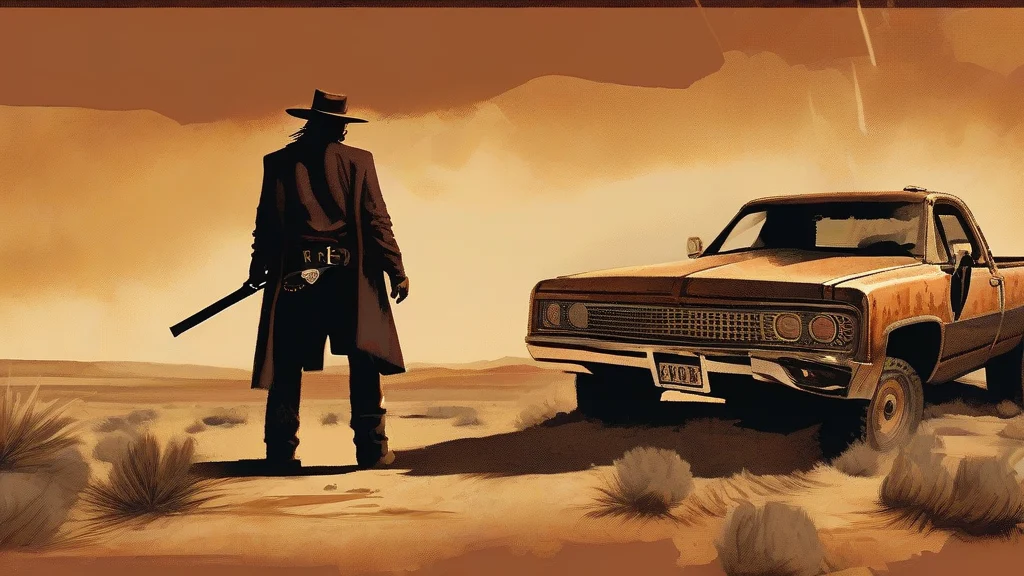
What does desperado mean?
A desperado is a reckless, dangerous outlaw — someone so hardened or desperate that they seem indifferent to capture or death. The word is most closely tied to the American Old West, where it described bandits, gunslingers, and fugitives whose violent lawlessness made them figures of both fear and dark fascination. Today it is used less as a precise legal term than as an evocative label, often with a romanticized or ironic edge: a character in a film might be called a desperado, or a friend who takes absurd risks might be teased with the title. The word entered English in the early seventeenth century from Spanish desesperado, literally "one without hope," and it still carries that undertone of a person pushed beyond ordinary limits. Both "desperadoes" and "desperados" are accepted plurals. Its enduring appeal owes much to popular culture, notably songs and films that cast the desperado as a lonely, doomed rebel rather than a mere criminal.
nounA bold, reckless outlaw or criminal, especially one who is desperate enough to disregard all danger; historically applied to bandits of the American West.
- A reckless, desperate outlaw or bandit, especially one associated with the American frontier West.
- By extension, any bold, lawless, or wildly reckless person.
"The wanted poster described the desperado as armed, dangerous, and likely to shoot first."
"Sheriff Tate vowed to track down the desperado who had robbed the stagecoach twice in a single month."
"In his youth he fancied himself a desperado, though his wildest crime was riding without a ticket."
Both plural forms are standard; "desperadoes" follows the older -oes pattern for words ending in -o after a vowel, while "desperados" is now equally common.
"The town's museum displays wanted posters of the desperadoes who once terrorized the territory."
The Eagles' gentle hit "Desperado" turned a word for a gun-slinging outlaw into shorthand for a lonely romantic rebel — one of music's great image makeovers.
Reviewed by Deb Chak, Editor. AI-assisted content curated by RJS Tech Solutions LLP.
Etymology of desperado
"Desperado" comes from the Spanish desesperado, meaning "desperate" or "hopeless," the past participle of desesperar, "to despair." English adopted it in the early seventeenth century, at first applying it broadly to any desperate or reckless criminal before it became strongly associated with the outlaws of the American frontier in the nineteenth century. It shares its deeper root with "despair" and "desperate," all ultimately tracing back to Latin sperare, "to hope."
How desperado is actually used
The word carries a strongly romanticized, Old West flavor today and is often used half-jokingly rather than as a sober legal term. Plural forms "desperadoes" and "desperados" are both standard.
Easily confused with desperado
"Desperate" is an adjective meaning filled with despair or urgency, while "desperado" is a noun naming a reckless outlaw.