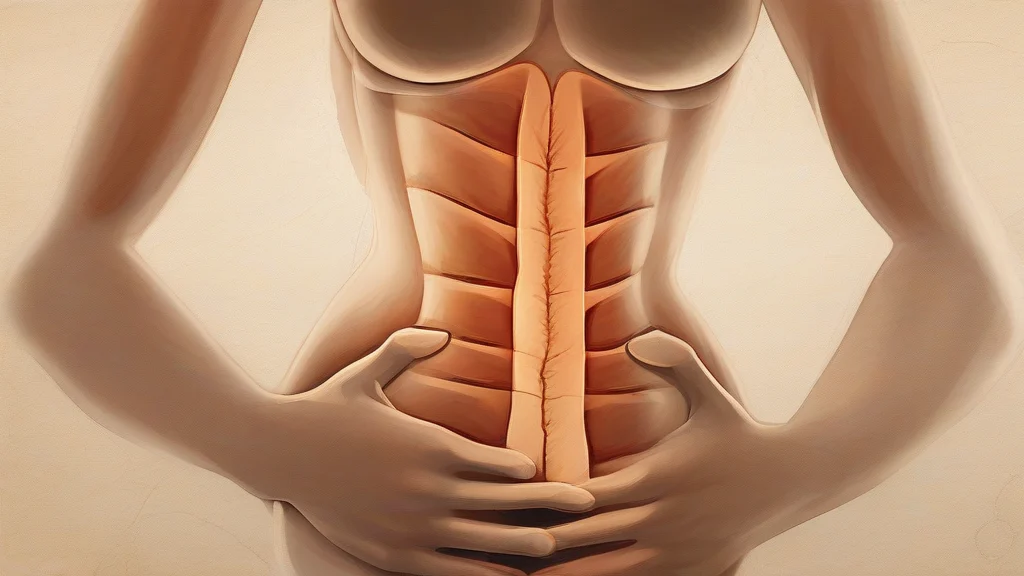
What does diastasis mean?
Diastasis is a noun denoting an abnormal separation or widening between two parts of the body that are normally joined. Its best-known use today is in the phrase diastasis recti, describing the gap that can open between the paired abdominal muscles along the body's midline, most often as a result of pregnancy but also seen in newborns and in people who lift heavy loads improperly. In cardiology, the word carries a second, older sense: the quiet interval within the heartbeat when the heart's ventricles relax and fill with blood before the next contraction. Derived from Greek roots meaning 'a standing apart', the term carries a precise, clinical register — you will meet it in a doctor's diagnosis, a physiotherapist's assessment, or a textbook, rarely in casual speech. It matters practically because recognizing a true muscular diastasis changes how exercise and rehabilitation should be approached.
An abnormal separation or divergence of parts of the body that are normally joined, especially the separation of the rectus abdominis muscles along the midline of the abdomen.
"The surgeon confirmed that the patient had a significant diastasis requiring repair."
Most commonly encountered in the phrase 'diastasis recti' in postnatal and fitness contexts.
In cardiology, the phase of rest in the cardiac cycle during which the ventricles fill with blood.
"The echocardiogram showed prolonged diastasis due to the slow heart rate."
The plural follows the Greek pattern, pronounced /daɪˈæstiːz/, and is used mainly in clinical writing when discussing multiple cases.
"The clinic reported treating numerous postpartum diastases over the past year."
That post-pregnancy 'mommy tummy' that crunches never fix? It has a medical name: diastasis recti — and sit-ups can actually make it worse.
Reviewed by Deb Chak, Editor. AI-assisted content curated by RJS Tech Solutions LLP.
Etymology of diastasis
Diastasis comes from Greek diastasis, meaning 'separation' or 'dilation', formed from dia- ('apart', 'through') plus the verb stem associated with standing or placing, so literally a 'standing apart'. It entered scientific English via Latin in the seventeenth century alongside its counterpart systole-related terminology for the phases of the heartbeat. It shares its ancient Greek root with words such as stasis, static, and ecstatic, all ultimately tracing back to the Indo-European base meaning 'to stand'.
Related word forms
How diastasis is actually used
A technical term used mainly in medicine, physical therapy, and fitness contexts; it is formal rather than everyday vocabulary. The sense referring to the abdominal muscle separation has become more familiar to lay readers through postnatal fitness discourse, where it often appears in the fixed phrase 'diastasis recti'.
Easily confused with diastasis
Diastasis is a physical separation of body parts (or the resting filling phase of the heartbeat), while diastole specifically denotes the phase of the cardiac cycle when the heart muscle relaxes and refills with blood.