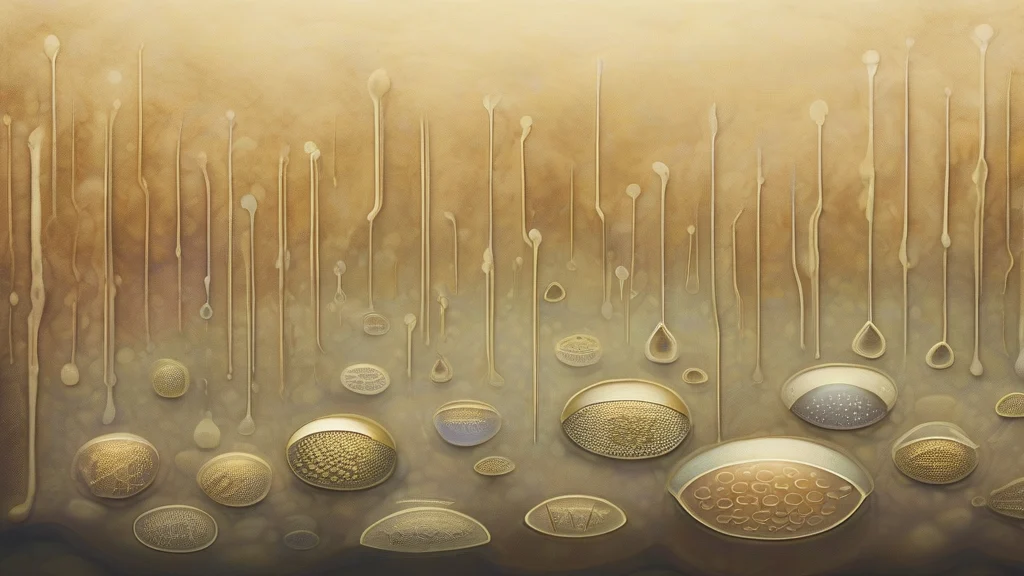
What does diatom mean?
A diatom is a microscopic, single-celled alga belonging to the class Bacillariophyceae, found in oceans, lakes, and rivers around the world. What makes diatoms remarkable is their cell wall, or frustule, which is made of silica — essentially glass — and is often ornamented with intricate, symmetrical patterns so striking that they have been compared to works of art under the microscope. Diatoms are among the most important primary producers on Earth: drifting as phytoplankton near the water's surface, they photosynthesize on a vast scale, form the foundation of aquatic food webs, and generate a substantial share of the oxygen we breathe. When they die, their glassy shells sink and accumulate in sediments; vast fossil deposits of these shells are mined as diatomaceous earth, used in filters, abrasives, and insecticides. Because different species tolerate different conditions, fossil diatoms also serve as valuable indicators of past environmental change. The word is chiefly scientific in register but appears regularly in ecology, geology, and climate science writing.
nounA microscopic single-celled alga of the class Bacillariophyceae, having a cell wall of silica consisting of two overlapping halves, found in freshwater and marine environments and forming a major part of plankton.
- A microscopic unicellular alga of the class Bacillariophyceae, characterized by a two-part silica cell wall (frustule) and abundant in oceans, lakes, and rivers as a major component of phytoplankton.
"Under the microscope, each diatom revealed an intricate glass-like shell etched with symmetrical patterns."
"Diatoms drift in the sunlit surface waters, photosynthesizing and anchoring the base of the marine food web."
"The lake's sediment layers were rich in fossil diatoms, allowing scientists to reconstruct water quality over thousands of years."
Regular English plural. Often used collectively to refer to the group as a whole.
"Diatoms produce much of the oxygen released into the atmosphere by marine life."
Every diatom builds its own miniature glass house — and the fossilized remains of trillions of them are mined today as the abrasive powder known as diatomaceous earth.
Reviewed by Deb Chak, Editor. AI-assisted content curated by RJS Tech Solutions LLP.
Etymology of diatom
The word 'diatom' comes from the Greek 'diatomos', meaning 'cut in half', formed from 'dia-' ('through, apart') and 'temnein' ('to cut'). The name refers to the alga's distinctive two-part silica shell, whose halves fit together like a small box and lid. The term was adopted into scientific Latin and entered English usage in the nineteenth century, when microscopy was rapidly advancing and these organisms were first being systematically described. It shares the Greek root 'tom-' ('to cut') with words such as 'anatomy' and 'atom' (literally 'uncuttable').
Related word forms
How diatom is actually used
A technical term used chiefly in biology, ecology, geology, and environmental science; rare in casual conversation. Plural is 'diatoms'. The adjective 'diatomaceous' (as in diatomaceous earth) is its most common derived form.
Easily confused with diatom
Diatomic describes molecules made of two atoms (such as O₂), whereas a diatom is a microscopic silica-shelled alga.