
What does dibbing mean?
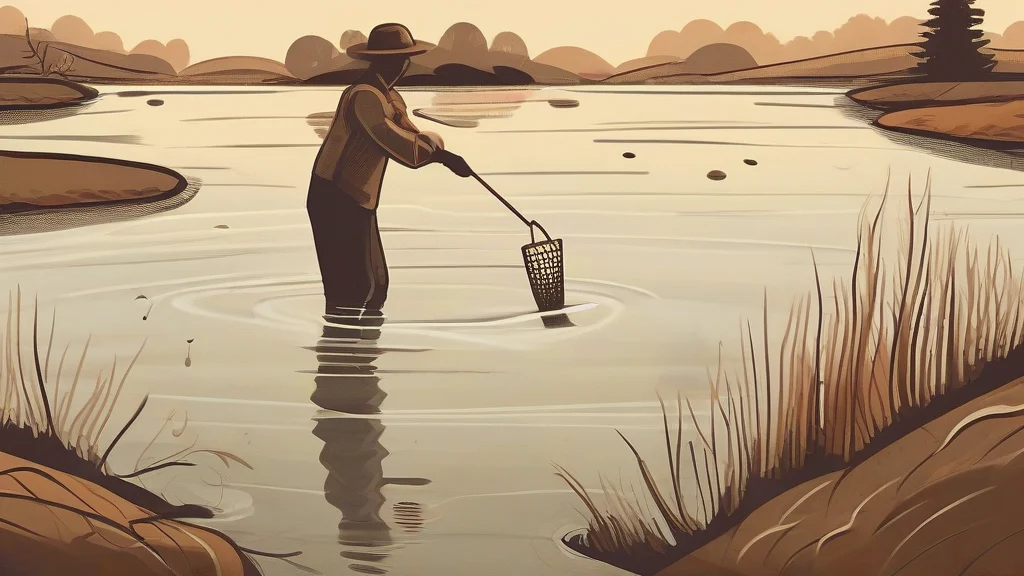
Dibbing is the present participle of the verb "to dib," meaning to dip or plunge something lightly and repeatedly, most often into water or soil. It survives today in two main contexts. In angling, particularly traditional British coarse fishing, dibbing refers to lowering a baited hook gently into likely spots—under banks, beside reeds—in search of fish. In horticulture, it describes the practice of using a dibber, a pointed stick or handled tool, to bore small holes in which seeds, bulbs, or seedlings are set out. The word carries a distinctly rustic, old-fashioned connotation, evoking pre-industrial country life, and is far more common in British than American English. Though rarely heard in casual conversation, it remains current in specialist gardening literature and among traditional anglers, giving writers a precise and evocative term for these quiet, deliberate acts of placing things carefully by hand.
To dip or lower something, especially a fishing baited line or a planting implement, briefly into water or soil.
"They were dibbing for trout in the shaded pool below the weir."
Chiefly British; commonest in traditional angling and gardening registers.
The action or practice of dipping a fishing line or making planting holes with a dibber.
"Dibbing was once the standard method for setting out brassica seedlings."
Before garden trowels were commonplace, every English gardener carried a 'dibber'—a simple pointed stick—and 'dibbing' holes for seeds was how entire fields got planted.
Reviewed by Deb Chak, Editor. AI-assisted content curated by RJS Tech Solutions LLP.
Etymology of dibbing
The verb "dib" first appears in English in the early seventeenth century, originally meaning to thrust or dip sharply, and it gave rise both to "dibbing" in fishing and planting and to the gardening tool called a "dibber." Its further origin is uncertain; it may be imitative or related to "dip," and it should not be confused with "dibs," the noun used in children's games to claim a right to something, whose etymology is separate and obscure.
Related word forms
How dibbing is actually used
"Dibbing" is chiefly British and somewhat old-fashioned or rural in flavor, appearing mostly in traditional gardening writing and coarse-fishing contexts. In American usage it is rare, though the horticultural sense survives among heirloom-gardening enthusiasts.
Easily confused with dibbing
Dibs is a noun meaning a claim or right to something ('I call dibs'), while dibbing is the present participle of the verb 'to dib', meaning to dip or plant.