What does dingo mean?
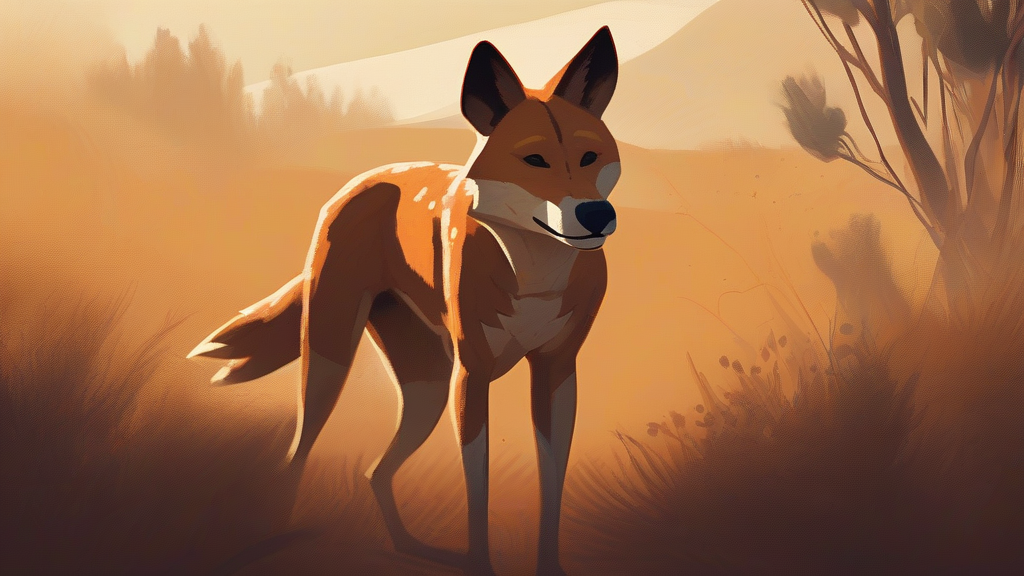
A dingo is a wild dog found primarily in Australia, where it occupies the role of apex land predator. Typically golden or reddish-tan with a lean, wolf-like build, the dingo is thought to descend from domesticated dogs brought to the continent by Asian seafarers several thousand years ago, making its status as either a distinct species or a feral dog a matter of ongoing scientific debate. Dingoes hunt small mammals such as rabbits and kangaroos and are regarded by farmers as pests because they attack livestock, prompting the construction of the vast 'dingo fence' that stretches across parts of southeastern Australia. In informal Australian English, 'dingo' doubles as an insult for a cowardly or disloyal person. The animal gained international notoriety through the phrase 'a dingo ate my baby,' linked to a famous 1980 disappearance case. Whether viewed as pest, predator, or protected native wildlife, the dingo holds a singular place in Australia's ecology and culture.
A wild dog of Australia, typically sandy-yellow in colour, descended from dogs introduced in prehistoric times and considered by some taxonomists a distinct species (Canis dingo) and by others a subspecies of the grey wolf.
"The ranger explained that pure dingoes rarely bark, communicating instead with howls and whines."
Australian informal: a cowardly or treacherous person.
"Only a dingo would abandon a mate in trouble like that."
'Dingoes' is the standard plural; the variant 'dingos' appears but is less common in edited writing.
"Dingoes roam much of mainland Australia but are absent from Tasmania."
The phrase 'a dingo ate my baby' entered pop culture through a real — and tragic — Australian court case from the 1980s.
Reviewed by Deb Chak, Editor. AI-assisted content curated by RJS Tech Solutions LLP.
Etymology of dingo
The word 'dingo' comes from Dharug (also spelled Dharruk), the language of the Aboriginal people of the Sydney region of New South Wales, and entered English via European settlers in the late eighteenth century, shortly after British colonisation of Australia began in 1788. It belongs to the same family of loanwords as other Australian Aboriginal borrowings such as 'kangaroo,' 'koala,' and 'wombat.' The word has remained essentially unchanged since its adoption into English.
How dingo is actually used
The literal sense is standard worldwide; the slang sense is chiefly Australian and informal, carrying strong negative connotations. The plural 'dingoes' is standard, though 'dingos' also occurs.
Easily confused with dingo
A dugong is a large marine mammal related to manatees, whereas a dingo is a wild land dog; the two words merely look somewhat similar.